My Big Day Out - Billy the Seal

Peter Howlett, 23 Mai 2012

Well, I thought things had looked up when I was put on display in the Clore Discovery Gallery. After so many years of just seeing the inside of museum stores it was great to be able to see visitors again!

Then came news that the BBC were to film me for a piece in their series called Coast, and, even better they wanted to film me on Exmouth beach - a day out - wow! Easy for me to say but this meant quite a bit of work for my curator, Peter Howlett, who had to get me ready, strap me into the van and do all the driving.

Anyway the big day arrived and I was loaded into a van for the journey down. It was great to see the world outside of Cardiff again - the first time since I was brought in on that trawler back in 1912. It was fantastic to see the sea again, even if it did get a little close during filming.

I was filmed with the skeleton of a Common Dolphin (courtesy of the Hebridean Whale and Dolphin Trust), I don't know about you but I think I'm far more impressive. The idea was to show why us Grey Seals are quite happy bouncing around on dry land when a dolphin ends up dead if it gets stranded. To explain this I had the company of one of Coast's presenters, Miranda Krestovnikoff. It took a while to set everything up but eventually they were ready and I got ready for my close up with Miranda - I think she was quite taken with me! It was rather nice being fimed on the deserted beach in the early evening sun.


Sadly my day out was now over and I was put back into the van for the journey back to the Museum and the following morning I was back in my usual place surveying the visitors in the Clore Discovery gallery. Keep an eye open for my appearance, I should be in one of the programmes to be screened next spring/summer.

Billy

Arctic Ocean exploration 12th May

Peter Howlett, 21 Mai 2012

And so to Bodø. Unfortunately the first half of the MAREANO spring 2012 research cruise is at an end.  We have arrived in Bodo, the largest city in Nordland county. The views from the bridge of the G.O. Sars reveal the port city  (pop. about 50,000) as fairly flat, surrounded by picturesque mountains.

At 10 o’clock, it is sunny and an exploratory walk to the marina and through the town is very pleasant; quite warm in the sun, but bitterly cold in the wind. A weekend marine festival is being set up around the marina and people are starting to arrive. Having got our bearings we return to the ship to say goodbye to many of our fellow scientists, who are catching a taxi to the airport. It is now 11 o’clock, the sky has darkened, and we have near horizontal snow! The sun reappears later, thankfully.

Scientists for the second two weeks of the sampling are beginning to arrive. For this leg, the ship will travel south from ‘Nordland VI’ to an area between Kristiansund and Halten. They will concentrate on video filming the marine habitats there and will not be deploying grabs, trawls or sledges. You can keep up-to-date at with the latest news of the project here.

After lunch we meet with Dr Børge Holte, head of the MAREANO programme, and cruise leader for the next leg. We discuss our work during the previous two weeks, and all agree that our participation with the Norwegian science team has been mutually beneficial. There was much in common between the MAREANO and our own series of scientific investigations of the seabed around Wales. You can find out more about the MAREANO project taxonomy here.


Throughout the first leg, we had been comparing and contrasting our similar, but differing, sampling techniques and sample processing procedures. We also had many discussions concerning the animals we find in the seabed habitats off our respective coasts. It was a pleasure to see some of the species we are familiar with (as well as others we rarely or never encounter) in the Arctic region from which they were first discovered.

The ship is set to sail at 3 p.m., so we say our farewells and go to our hotel for a brief rest before flying back to the UK on Sunday morning.

Apart from the port, the tourist appealing landscape and outdoor activities, Bodø is famous for hosting the National Norwegian Aviation Museum. This is situated beside the airport and both have strong links with the UK. The British built the first runway in 1940, when Germany invaded southern Norway. Then, during the Second World War, two Norwegian fighter squadrons flew Spitfires from England. Naturally, the Museum exhibits include the Spitfire alongside the numerous other military and civilian aircraft in its 10,000 m2 floorspace.

Once back in the UK we will post some photos of the animals we encountered during the trip. In the meantime, here are two photos of a small holothurian (sea-cucumber), Elpidia — affectionately referred to as a ‘sea-pig’ by all aboard the research ship. These interesting animals ‘graze’ the surface of the seabed.  This particular species grows to around 2 cm in length, but this specimen (from 1,300 m depth) is only about 4 or 5 mm long. The animal can be seen in situ in a photo from an earlier MAREANO research cruise here

Bylbiau'r Gwanwyn i Ysgolion: Canlyniadau 2005-2012

Danielle Cowell, 16 Mai 2012

Mae project ‘Bylbiau'r Gwanwyn i Ysgolion’ yn gyfle i filoedd o wyddonwyr ysgol weithio gydag Amgueddfa Cymru i archwilio newid yn yr hinsawdd a'i ddeall.

Ers mis Hydref 2005, mae gwyddonwyr ysgol  wedi bod yn cadw cofnod o'r tywydd a phryd mae eu blodau'n agor, fel rhan o astudiaeth hirdymor o effeithiau'r tymheredd ar fylbiau'r gwanwyn.

Mae tystysgrifau wedi cael eu hanfon at yr holl ddisgyblion yn 2933 a gwblhaodd y prosiect eleni.

Mae rhagor o fanylion yn adroddiadau Athro'r Ardd neu gallwch chi lawrlwytho'r daenlen i astudio'r patrymau!

  • Gwnewch siartiau amlder a graffiau i ganfod y cymedrau.
  • A wnaeth blodau agor yn hwyr mewn ysgolion oedd yn cofnodi tywydd oer?
  • Sut wnaeth tymheredd, heulwen a glaw effeithio ar ddyddiadau blodeuo ar gyfartaledd?
  • Chwiliwch am dueddiadau mewn gwahanol lefydd yng Nghymru.
 

Cystadleuaeth Darlunio Cennin Pedr 2012.

Llongyfarchiadau i'r disgyblion canlynol am creu darluniau botanegol ardderchog!

1af: Sana Patel - Fulwood & Cadley Primary

2ail: Markus - Stanford Primary - Age 9

3ydd: Emilia Porter - Fulwood & Cadley Primary

Goreuon y Gweddill:

  • Marielle Matter - Westwood Primary - Age 9
  • Emlyn Piette - Westwood Primary - Age 10
  • Aleena Raza - Fulwood & Cadley Primary
  • Lucy Turner - Fulwood & Cadley Primary
  • Davina Vadhere - Fulwood & Cadley Primary
  • Bradley Cox - Stanford in the Vale Primary - Age 9
  • Abigail Boswell - Fulwood & Cadley Primary
  • Hasan Patel - Fulwood & Cadley Primary
  • Tom Betheridge - Fulwood & Cadley Primary
  • Mairelle Mattar - Westwood Primary - Age 9
  • Hasan Ali - Sherwood Primary
  • Charlie Smith - Ysgol Nant Y coed - Oed 9

Diolch yn fawr

Athro'r Ardd

www.museumwales.ac.uk/scan/bylbiau

Twitter http://twitter.com/Professor_Plant

Facebook Professor Plant


Cardiff Creative Writers

Grace Todd, 14 Mai 2012

Objects are evidence of somewhere, something, or somebody and as such all have stories to tell.

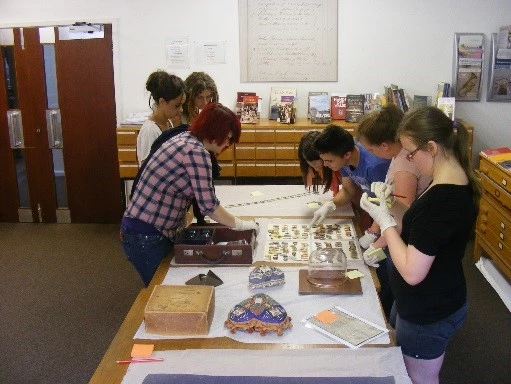
Recently a class of adults studying creative writing at Carduff University attended a workshop here with me in the Clore Discovery Centre. They took on the role of a curator and wrote their own creative labels for some of their favourite objects in the gallery. Here are a few examples:


Iron-Nickel Meteorite (Approximately 4.5 billion years old)

 I wandered lonely, in a cloud of fragments, beyond the Martian orbit, since the beginnings of the Solar System some four-and-a-half billions of years ago. A passing satellite, en-route from Earth to who knows where, disturbed my orbit, and I fell towards the distant sun. Later, I felt the pull of Earth, and spiralled down into its gravity well – faster and faster until in fiery glory I blazed across the sky, a meteorite. Though reduced in size, I fell to earth. A fragment of the ancient history of the Solar System – a messenger from outer space – here I lie in The National Museum Collection.

David Edwards


What is it? Popular wrong answers include a drinking vessel or a paperweight!!

 It is an axe head. Bronze Age man hafted it to a wooden handle and used the D shaped loop on the side for strapping.  Butchering, wood-cutting and self-defence are among possible uses for this versatile tool.

 Mike Dolan


A snakestone fossil

thought to be magic,

I was a cephalopod

with head and foot fused.


In life I relied

on plain hydraulics

a siphuncle curled

like a twirling straw


adjusted the pressure

in my chambered coils,

let me rise and fall

as I dodged ichthyosaurs.


Anne Bryan


Arctic Ocean exploration 11th May

Peter Howlett, 11 Mai 2012

Friday
Since the last blog we have moved to shallower water which means that it takes a much shorter time to take the samples, less time between stations and a more hectic schedule. With the 12 hour shifts I have had little inclination to sit at the computer. Perhaps most spectacular have been the samples from the sponge grounds, some of these are the size of footballs. They are difficult to work with without gloves because of the spicules and worsened by the rather nauseous smell given off by some. Sorting and fixing such a large sample had everyone running around madly.


The Campod live video gear has been working, it is lowered to the sea bed and then hopped along a transect some 700metres long. The footage is stored and the megafauna analysed to create a chart of animal communities. You can see some of this video on the Mareano website http://www.mareano.no/english/. You can also read all about the programme in detail. We did a similar thing for the seas around Wales and published the results in our Biomor Reports but we did not have the video or geophysical data to go with our benthic sampling, wouldn’t it be interesting to have seabed images for all the communities we have found in the Irish Sea?


As far as my research goes we have collected a lot of relevant material. Firstly I have seen common Norwegian Sea species that just enter the British fauna and some that are found in both regions or so we think! I now have material of thyasirid bivalves to compare with those we have from the Atlantic Frontier Environmental Network  (Shetland-Faeroes) programme and can hopefully describe some new species now.


There is one family of bivalves that are always problematic, the Astartidae, and I now have a good series of northern A. sulcata fixed in 100% ethanol and RNA later for a molecular study that might be joint with the Bergen Museum.


I have not got Anna any Macoma for her tellinid study but I do have quite a few Abra longicallus a species we only get on the Porcupine Bank west of Ireland.


Andy has been building up an impressive collection of photographs of living polychaetes, he will post some of these on our “return to home” final blog.


We dock early tomorrow morning in Bodo so it is now a frantic pack, tidy and clean period so I had better go.