Polychaete research in the Falklands by Teresa Darbyshire - day 26-28

My directions turned out to be accurate and easy to follow and I arrived at Teal Creek in plenty of time for the tide. The biggest problem I had was deciding where to stop along the creek. At the time I arrived the tide still had a way to go out so it was difficult to know how much ground would be uncovered. I made my decision and walked out into the small inlet off the creek (photo 1). The area was very soft but the depth of the mud varied and I didn’t venture too far into deeper areas, wary of getting stuck. As I dug around I was surprised to find the same new ragworm that I had found at Sand Bay the previous day, having not found it at any site before and now two in a row. There were also many of the bamboo worms that seem to dominate the shores here.


I left the creek shortly before actual low tide in order to give myself time to get over to Camilla Creek where low tide would be in just over 2 hours time. The tide hadn’t gone down much for a while so I didn’t think I would be missing anything new being uncovered.  As I drove out past the previous choices I had had for stopping in the area I realised that the earlier bays had much larger areas of mud flat exposed and I thought maybe I had made a mistake in my choice of sampling site. However, on reflection, the water had retreated to the far side of the creek from these bays and that would have left me with no access to water across the mud which is essential during the collecting, so I probably did make the right choice after all.


Camilla Creek was reached fairly quickly with some expanses of mud flat already exposed. It was a much larger, wider creek (photo 2) than Teal but the shore itself seemed more gravelly leading down to it. I quickly realised that although the approach was easier, the mud itself was softer and deeper and probably not to be ventured too far into without additional company for safety and better sampling gear than what now felt like a very short pair of wellies. After extricating myself from the mud I skirted around the edge of the water level in the small bay sampling different spots and finding quite a variety of different mud, sand and hard areas to try.


Eventually it was time to leave for the journey back. This time I kept the window tightly shut and arrived back slightly less dusty than the previous night. There was at least one new worm for my list from the samples in the form of another different paddleworm (photo 3).


Saturday saw the last of the formaldehyde to alcohol changing where possible. The later samples would all have to stay in formaldehyde though as they needed to stay in that fluid for at least a few days to make sure they were properly ‘fixed’ before being moved to alcohol. That will now be done after both I and they arrive back in Cardiff. This was then followed by several hours of painstakingly sealing and taping around the lid of each pot and then sealing them into bags in order to reduce the risk of any fluid leakage during transport. As there were around 200 pots to do this took a while! The photo shows all of the pots at various stages of packing.


This morning (Sunday) saw a few more hours of sealing and packing until I had 7 boxes of packed samples ready for posting tomorrow (I can’t bring them back on the plane with me sadly).
There had been plans to do a last shore dive locally this afternoon but unfortunately the wind has scuppered our plans, blowing strongly all day. As it would have been a shallow site with entry off the shore, the windy conditions would have made getting in and out of the water difficult, conditions underwater uncomfortable and visibility poor, so an obvious decision was made. Still disappointing though as everyone had told me what a lovely dive it was going to be!


Tomorrow’s plan includes my final talk at the Fisheries Department in the morning followed by getting those parcels on their way and then getting my own packing started. Only one more day left here!

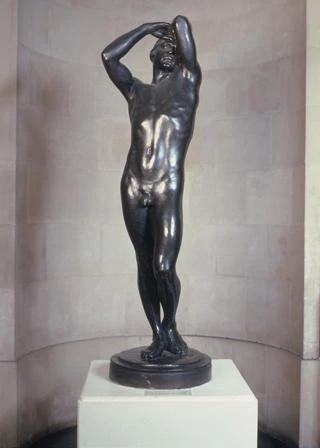
William Goscombe John (1860-1952)

Morffews
Morpheus

William Goscombe John (1860 - 1952)

Icarus
Icarus

Sir Alfred Gilbert (1854 - 1934)

Roedd Cymru yn yr oes Edwardaidd yn gyforiog o gyfoeth y diwydiannau glo, haearn a dur, ac yn llawn cyfleon i gerflunydd. Mae cofebion cyhoeddus William Goscombe John i'w gweld ledled Cymru ond yn enwedig yn ei dref enedigol, Caerdydd. Ef hefyd a ddyluniodd medalau buddugol yr Eisteddfod Genedlaethol, sy'n dal i gael eu defnyddio heddiw.

Torri cwys

Ganwyd William John yng Nghaerdydd ym Mawrth 1860. Mabwysiadodd yr enw Goscombe o bentref yn Swydd Gaerloyw ger hen gartref ei fam. Roedd ei dad, Thomas John, yn gerfiwr coed yn y gweithdai a sefydlodd yr Arglwydd Bute i ailwampio Castell Caerdydd. Ymunodd William â'i dad pan yn 14, gan astudio yn Ysgol Gelf Caerdydd ar yr un pryd.

Ym 1881 symudodd i Lundain fel disgybl gynorthwy-ydd i Thomas Nicholls, y cerflunydd oedd yn gyfrifol am Wal Anifeiliaid y Castell. Parhaodd â'i astudiaethau yn Ysgol Gelf Kensington, ac yn Ysgolion yr Academi Frenhinol o 1884, lle y dysgodd fodelu naturiaethol mewn clai yn y dull Ffrengig, dull a gyflwynwyd i Lundain yn y 1870au gan Jules Dalou.

Roedd yn fyfyriwr athrylithgar, ac fe deithiodd ymhell. Treuliodd flwyddyn ym Mharis, yn cynnwys cyfnod yn stiwdio Rodin. Ym 1890 dychwelodd i Lundain ac ymsefydlu yn St John's Wood.

Mae ei gerflun Morpheus, a ddangoswyd yn Salon Paris ym 1892, yn dangos yn amlwg ddylanwad Rodin.

Y 'Gerflunwaith Newydd'

Nod cerflunwyr yng nghenhedlaeth John oedd ceisio creu cerfluniau mwy dynamig drwy bortreadu'r corff dynol mewn modd hynod naturiaethol. Dyma benllanw traddodiad cerfluniol oedd â'i wreiddiau yng nghyfnod y Dadeni, a dyma Rodin a'i gymdeithion yn aildanio'r traddodiad yn Ffrainc yng nghanol y bedwaredd ganrif ar bymtheg. Dilynwyd llwyddiant Morpheus gan gerflun o Ioan Fedyddiwr ar gyfer yr Arglwydd Bute, a grŵp o noethluniau maint llawn yn cynnwys Bachgen yn Chwarae a Coblyn. Mae'r rhain yn dangos ei feistrolaeth wrth lunio'r ffurf ddynol.

Erbyn diwedd y 1890au roedd Goscombe John wedi gwneud enw i'w hun, ac wedi arddangos ei waith yn genedlaethol ac yn rhyngwladol. Daeth sawl comisiwn cyhoeddus mawr i'w law ac roedd yn brysur iawn yn y blynyddoedd cyn y Rhyfel Byd Cyntaf.

Cymru a'r Ymerodraeth

Er ei fod yn byw yn Llundain, roedd John yn ystyried ei hun yn gerflunydd cenedlaethol Cymru. Ym 1916 cyfrannodd ganolbwynt marmor Bendith Dewi Sant i'r Bobl i grŵp o ddeg ffigwr a wnaed ar gyfer Neuadd y Ddinas Caerdydd. Derbyniodd sawl comisiwn hefyd gan Gymry blaenllaw'r oes. Adeiladodd John ei yrfa drwy ffyddlondeb i noddwyr lleol, ond derbyniai waith o bob cwr o'r Ymerodraeth, megis Beddrod y Prif Weinidog Ceidwadol, yr Arglwydd Salisbury, yn Abaty Westminster, a'i gerflun marchogol o'r Brenin Edward VII yn Capetown.

Ei gerflun cyhoeddus mawr cyntaf oedd cofeb Catrawd y Brenin (1905) yng nghanol Lerpwl; gwaith oedd yn ymgorffori milwyr o hanes y gatrawd, yn cynnwys y Drymiwr Bach anferth, ei waith enwocaf.

Cyfunwyd y Cymreig a'r Ymerodrol mewn comisiwn ar gyfer regalia arwisgo'r Tywysog Edward (Edward VIII yn ddiweddarach) yng Nghastell Caernarfon ym 1911. Dyluniodd John goron, modrwy, teyrnwialen a chleddyf oedd yn ymgorffori eiconau 'Cymreig' o ddreigiau, cennin Pedr a chlymau Celtaidd.

Doedd gan John fawr i'w ddweud am gerflunwaith modern a elwai yn gerflunwaith 'Ynys y Pasg', gyda'i bwyslais ar gerfio'n uniongyrchol i'r garreg. Roedd tuedd beirniadol yn datblygu hebddo erbyn 1914, ond daeth trasiedi'r Rhyfel Byd Cyntaf â sawl comisiwn newydd am gofebion, nifer ohonynt yng Nghymru.

Goscombe John a'r Amgueddfa Genedlaethol

Roedd Goscombe John yn un o sylfaenwyr Amgueddfa Cymru a bu'n aelod o'r Cyngor am dros deugain mlynedd gan chwarae rôl flaenllaw wrth bennu tuedd y casgliad celf i'r dyfodol. Yn ogystal â chasgliad cynhwysfawr o'i weithiau ei hun, mae ei roddion i'r Amgueddfa yn cynnwys gwaith nifer o'i gyfoedion yn y mudiad Cerflunwaith Newydd, yn cynnwys Icarus, gan Alfred Gilbert a gweithiau gan nifer o artistiaid a edmygai.

Polychaete research in the Falklands by Teresa Darbyshire - day 25

Wow, what a glorious day! It’s a bank holiday here but unlike most in the UK, a bank holiday with fantastic weather. The temperature is 18degC, that may not sound that high but it feels very warm and the burn factor is quite high. It’s been strange driving along listening to the radio reporting the weather in the UK which I hear is particularly bad right now. I am very thankful for being where I am!

This morning’s sampling site was Sand Bay, near Port Harriet, about a half hour drive out of Stanley. The bay opens out quickly to a wide area of sand (photo 1). The sand varies quite widely across the bay from very coarse to fine, sometimes with gravel or rocks and in other places just sand. The animals themselves also seemed to change accordingly so it was worth dotting my sampling sites around the bay.

Although at first this bay didn’t seem that much different to several of the other sites I’ve been to, a couple of the samples turned up some very different animals.

The most interesting was in a patch of the ‘solid’ sand, no stones but with some layers of old plant material as you dug down. Burrowing into those layers were a different sort of ragworm to any of those I’ve seen in any of my other samples, with striking red and white colours along its body (photo 2). I spent a while collecting several of these as they were obviously a different species to those I already had.

There was also a different type of paddleworm, the longest yet (photo 3), from one of the other sample spots. I only found one of these though.

By the time the tide turned, I had a large collection of pots from the different sites around the bay and a few animals that I already knew would be new to my list. As I wanted to get some photos of the ragworm with its colours I decided to go back into Stanley to the Fisheries lab rather than head straight out towards Darwin. I wasn’t that far away and it was worth the time. After a quick photo session I then got back on the road again, back out past where I had already been that morning and on to Darwin which would be nearly a 2 hour drive.

As it was such a warm and dry day I had the window open slightly but wasn’t prepared for just how much dust was created driving along the gravel roads. It was only when I arrived here at Darwin that I realised that the car, both inside as well as out, and myself, were coated in the dust.

I have been given instructions on how to get to the two creeks I want to sample tomorrow and hopefully they will also provide some interesting finds to end the week.

christmas decorations part two.

In my last post I mentioned that I would be running a drop in arts and crafts session on the 17th december in Oriel 1, St Fagans: National History Museum. We will be taking inspiration from 1950s decorations, and to get some good ideas I went around the site with my camera the other day and took these photos.

Do you have anything similar at home? don't forget to let me know your memories of Christmas decorations in your house when you were growing up too!

Polychaete research in the Falklands by Teresa Darbyshire - day 24

Back out to the shore this morning with Freya for company once again. We were only going a short distance outside of Stanley to an inlet called Mullet Creek (photo 1). This was a stream flowing down towards a sea inlet surrounded by coarse gravelly sand at the higher end, changing to a medium sand further down towards the sea. It was surprisingly less soft than I expected but still had a similar fauna to the site I sampled up at Mount Kent that had been much softer. It wasn’t quite as far down to the sea as it had been at Mount Kent, where I never even got close to finding where the sea had gone to).


I collected more of the Boccardia species (photo 2) that I thought might be different to the first one I had found which burrows into hard places such as the calcareous algae. These are very small and require a long time spent kneeling on the sand teasing them out of the surface layers (photo 3). There were also more paraonids, including more whole specimens, which is always good to find as opposed to small pieces!


The sea did still go out a long way as the inlet was very shallow. We were still heading down it when we came up to a fence that came part way out into the inlet. This was a minefield warning fence and so that was the end of our journey down the inlet. We still managed 6 separate sampling spots spaced out ranging from what would be ‘high shore’ to what was virtually ‘low shore’ so we didn’t do badly.


The sun didn’t come out for most of our sampling which kept it a little cool but also meant we were less likely to burn. It did come out as soon as we were finished though to warm us up.


A few hours back at the lab going through the samples and then a bit more formaldehyde to alcohol changing finished off the day.


The next couple of days will be quite busy. I’ll be sampling at Port Harriet tomorrow morning, a little further out from Stanley than I went today and then from there I’m heading west to Darwin for the night. Darwin is a couple of hours away on a narrow strip of land that connects the two sections of East Falkland, one northeast the other southwest, together. With sea on both sides but from completely different sides of the island, I’ll be able to sample two sites on Friday morning which have tides nearly two and a half hours apart. I’ll then head back to Stanley where I can sort the samples out in the evening. That will then be the last of the shore sampling!