Sbaddu Malwod a Straeon Eraill

Meinwen Ruddock-Jones, 15 Gorffennaf 2016

Mae’n ganol Gorffennaf.  Mae’r ardd yn ei blodau, y llysiau yn wyrdd ac yn iachus a brwydr flynyddol y garddwr (neu’r archifydd yn yr achos hwn) a’r falwoden ar ei hanterth. 

Mae’n debyg bod gan y falwoden gyffredin tua 14,000 o ddannedd (neu rychau ar ei thafod i fod yn fanwl gywir) ac wedi iddi dywyllu, o dan olau lleuad, gall y gelyn gwancus hwn a’i ffrindiau achosi armagedon yn y borderi gan ddinistrio misoedd o dyfiant mewn un noson o wledda.

Rhaid cymryd camau dybryd i arbed hyn rhag digwydd!

Felly, i ymddiheurio i’r malwod hynny sydd efallai wedi cwrdd â’u crêwr ychydig yn gynharach na’r disgwyl trwy amryfal ffyrdd yn yr ardd eleni - dyma bedwar pwt diddorol o Archif Sain Amgueddfa Werin Cymru am y lladron llwglyd llithrig.


Sbaddu Malwod yn Abergorlech

Yn ôl Garfield Evans a anwyd yn Abergorlech yn 1909 ac a recordiwyd gan yr Amgueddfa yn 1977, roedd hi’n arfer yn yr ardal ar ddechrau’r ganrif i chwarae tric ar unrhyw blentyn dieithr a fyddai’n dod i’r ysgol.  Byddent yn gofyn iddo  “Wyt ti wedi gweld sbaddu malwed?”.  “Na” fyddai’r ateb bob tro.  Wedi dal sylw y plentyn newydd byddai un o’r bechgyn yn codi dau ddarn o bren ac yn mynd i chwilio am falwoden.  Wedi dod o hyd i’r falwoden, byddai’r bachgen yn ei chodi a’i gosod i orwedd wyneb i waered ar y ddau ddarn o bren.  Wrth i’r plentyn newydd syllu ar y falwoden, ac agosáu yn gegrwth ati, byddai’r daliwr yn taflu’r anifail druan yn sydyn i’w geg.


Llafarganu i’r Falwoden

Yn ôl Sian Williams a anwyd yn Nhyn-y-gongl, Môn, yn 1896, ac a recordiwyd gan yr Amgueddfa yn 1973, nid oedd ganddi hi a’i ffrindiau lawer o deganau pan yn blant.  “Efo malwod oeddan ni’n chwarae’n blant, toedd gynno ni ddim byd arall.”  Byddent yn dal malwoden yr un, gosod y malwod ar garreg y drws a llafarganu iddynt:  ”Horn, horn, estyn dy bedwar corn allan, neu mi tafla’i di i Bwllheli, at y neidr goch i foddi” . Y plentyn â’r falwoden a fyddai’n tynnu ei phedwar corn allan yn gyntaf oedd yr enillydd. 


Meddyginiaeth ar gyfer Llyfrithen

Yn ôl Blodwen Gettings a anwyd yn 1911 yn Llangwm ac a recordiwyd yn Saesneg gan yr Archif yn 1983, roedd gan y gymuned hon ger Hwlffordd feddyginiaeth wahanol iawn i’r cyffredin ar gyfer cael gwared o lyfrithen ar y llygad.  I ddechrau, gellid rhwbio’r llyfrithen â modrwy briodas neu â chynffon cath, ond os na fyddai hynny’n gweithio, roedd un awgrym arall.  Rhaid oedd dod o hyd i ddraenen o lwyn y ddraenen wen ac un falwoden dew o’r ardd.  Wedyn aed ati i bigo’r falwoden â’r ddraenen ac arllwys yr hylif a ddeuai allan ohoni i mewn i’r llygad.


Pennill i’r Falwoden

I gloi, dyma bennill i’r falwoden gan Robin Lewis y Craswr o Felin Glasfryn.  Clywodd William John Edwards, a anwyd yn 1898 ac a fagwyd ym Mhentrellyncymer, y rhigwm hwn gan ei fam pam oedd tua 15 oed ac fe’i recordiwyd yn ei adrodd gan yr Amgueddfa yn 1973.

Malwen Ddu ar ochr wal,

Slip a meddal a annodd ei dal.

Well gen i un ddu nac un wen,

A dau gorn o boptu’i phen.

Dust. Anybody? No? Dust. Anybody? No.

Stefan Jarvis, 13 Gorffennaf 2016

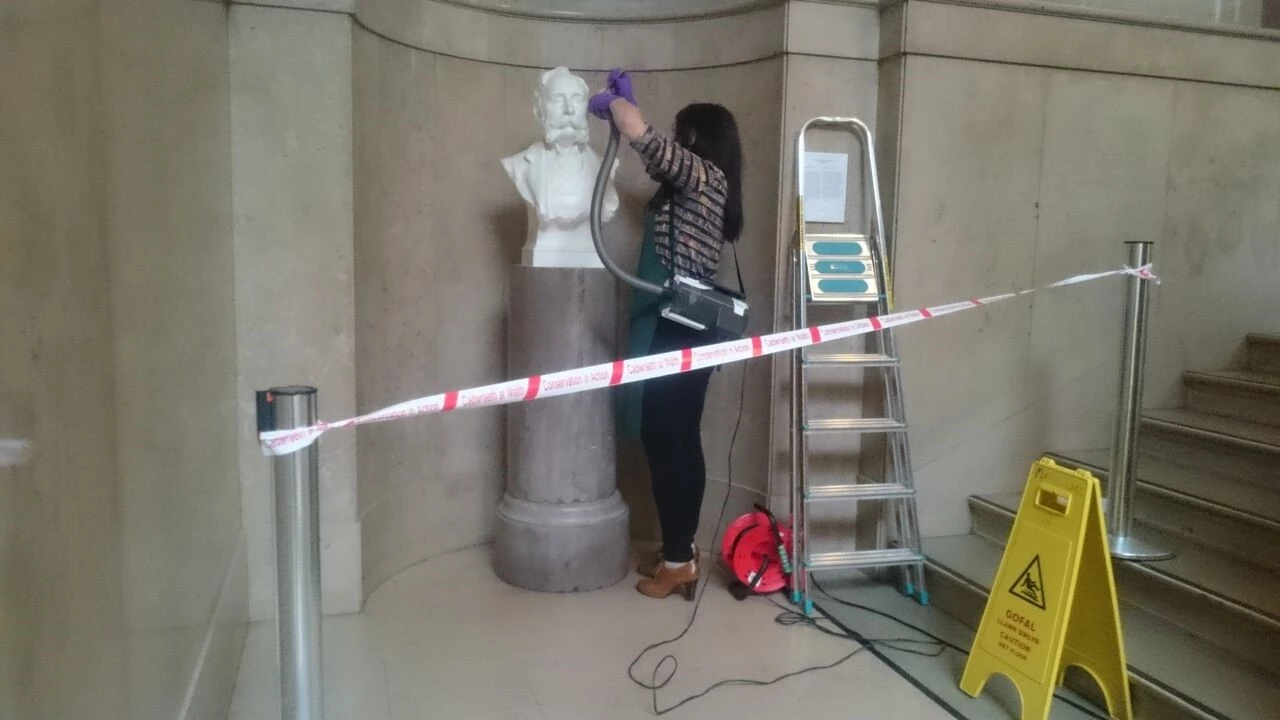
Keen-eyed visitors to National Museum Cardiff may have noticed recently the presence of little pieces of black card in some of the galleries. These pieces of card are there to serve an important purpose: to gather dust. And they are not only in the galleries; we distributed some in collection stores, too.

We want to know just how much dust is building up in parts of the museum. We also want to know what kinds of dust we are dealing with. We can only get this information by monitoring dust deposition.

So what’s the big deal with dust? What harm can a bit of dust do?

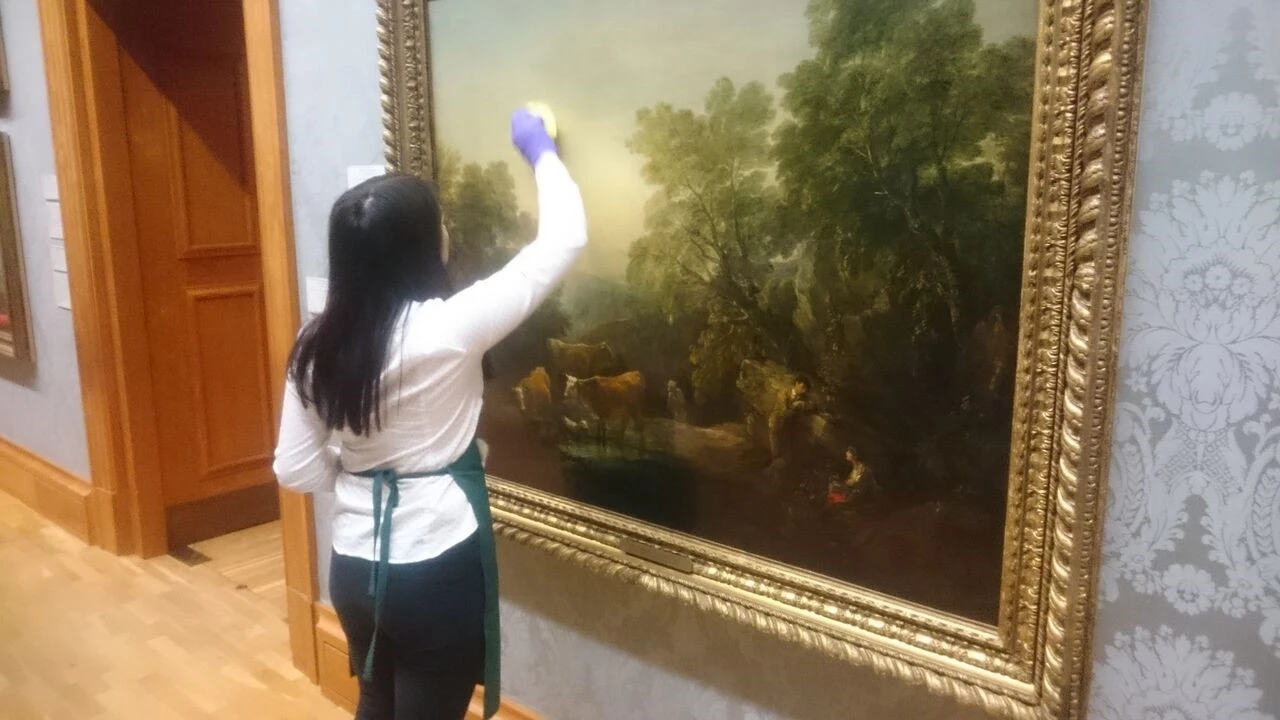
Well dust is unsightly from an aesthetic point of view. In addition, it can actually damage the museum’s collections. When dust sticks to a surface, it really sticks to it. Some types of particles can scratch and mark the surface of objects as they act like an abrasive; this is why when we clean museum objects we are extremely careful not to cause any scratching. Dust also attracts moisture, and surfaces covered in dust are at risk of wicking moisture onto the surface of object which can cause damage. This is especially the case on those horrible rainy days.

So both cleaning the dust and leaving it on risks damaging objects, but by monitoring the dust we can ensure that those risks are kept low and your enjoyment of the exhibits remains high.

Stefan is a student at Cardiff University and currently undertakes research for his MSc in Care of Collections at National Museum Cardiff in conjunction with the Preventive Conservation team.

Find out more about care of collections and Preventive Conservation at Amgueddfa Cymru - National Museum Wales here


Lost Cities of the World

Jeannette Rose Marxen, 10 Gorffennaf 2016

Archaeologists and adventurers have long been fascinated with “lost cities”.  The fabled city of Atlantis is probably one of the first lost cities to catch the imagination of people.  The Greek philosopher Plato wrote of the disappearing island in the 4th century BC.  During the Age of Exploration, from the 15th to 17th centuries, European explorers went looking for fabled cities like Eldorado and the Fountain of Youth.  Whether the interest is fueled by stories of catastrophic events or of hidden riches, people have been compelled to search for these places.  While often times these places turn out to be more myth than fact, there have been several archaeological discoveries that have reintroduced the world to cities that had become lost to history, and some of these can be seen in Treasures: Adventures in Archaeology.

Machu Picchu

The Incas of South America had the largest empire in the Americas, spreading along most of the western coast.  Much of their empire was located in difficult terrain, the vast mountains and valleys of the Andes.  However, this did not stop them from building over 14,000 miles of paved road or constructing cities in remote areas.  Machu Picchu was built in one of the most remote areas of their empire in the 15th century.  It had been abandoned within a hundred years and became lost to all but the local indigenous people.  On the 24th of July 1911, American historian and adventurer Hiram Bingham III was led to the site and reintroduced Machu Picchu to the world.  The Spanish conquistadors had not found the mountaintop city and because of that the wealth of archaeological material remained intact for archaeologists to study.  It was enshrined as a UNESCO World Heritage Site in 1983 and in 2007 it was voted as one of the New Seven Wonders of the World in a public poll. 
    

Skara Brae

Population increase, dispute with neighbouring groups or changes in the environment can all lead groups to relocate.  Skara Brae, on Mainland in the Orkneys, was a Neolithic settlement dating back almost 5,000 years.  Located along the sandy coastline, it was a small settlement of only eight houses.  It was most likely only occupied for a century before the residents decided to move further inland.  Due to its location, once abandoned, it became buried beneath the ever blowing sands.  Some 4,000 years later, in 1850, a winter storm battered the coast and exposed the outline of some of the buildings.  It was not excavated until 1924 after one of the houses was damaged by another storm.  It is one of the best preserved Neolithic villages in Europe and was enshrined as a UNESCO World Heritage Site as part of the Heart of Neolithic Orkney group in 1999. 

Mesa Verde

The Southwest region of the US is full of heritage sites linked to the indigenous people who first arrived in North America from Asia.  The Ancestral Puebloan, or Anasazi, culture flourished in the Four Corners region (where Colorado, Utah, Arizona and New Mexico meet) between the 6th and 14th centuries AD.  They farmed and hunted along the plateaus (or mesas) of the canyon.  By the 12th century, they had moved from living on top of the mesas into the valleys where they built ornate cliff dwellings.  At Mesa Verde, Colorado, there are over 4,700 archaeological sites, 600 of them cliff dwellings.  The dwellings range in size from small rooms used for storage to multi-level villages.  The Anasazis disappeared by the beginning of the 14th century and Mesa Verde was lost in its remote setting for over 500 years.  It became a National Park in 1906 and a UNESCO World Heritage Site in 1978. 
 

Cantre'r Gwaelod

If you'd rather stay a little closer to home while searching out lost cities have no fear, Wales has its very own.  Cantre’r Gwaelod was once a kingdom of fertile land which sat off the coast in Cardigan Bay.  According to legend tragedy struck and the surrounding sea reclaimed the land.  In the Black Book of Carmarthen, written in the 13th century, the blame is laid at the feet of a well maiden who was ignoring her duty and let the well overflow.  In other tellings, it is the fault of a drunken guard who was in charge of closing the floodgates.  While there is no definitive proof of Cantre’r Gwaelod’s existence there are curious clues along the coast.  In several places between Aberystwyth and Harlech there is evidence of causeways stretching out into Cardigan Bay.  The remains of a forest,now underwater, can also sometimes be seen.  
   

Glamming up the worms!

Julian Carter, 8 Gorffennaf 2016

Our exciting, family-friendly exhibition ‘Wriggle’ has recently opened delving into the wonderful world of worms. Producing this exhibition has taken many months of planning, hard work and some excellent teamwork.

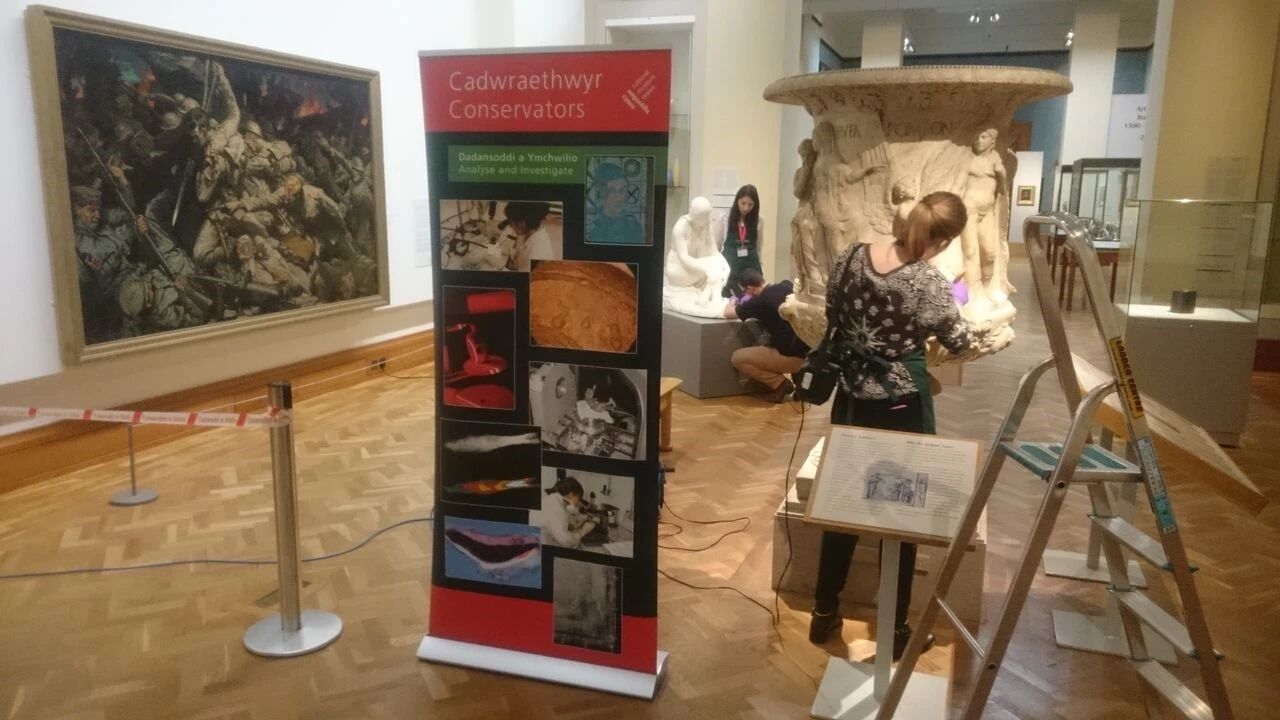
The natural science conservators have been very much part of that team, and in the run up to the opening we were very busy working on numerous specimens and creations. My talented colleague Annette focused on creating the beautiful mini dioramas and other displays in the wonderful ‘wriggloo’ center piece. However my role was to work on ‘glamming’ up the worms from our fluid preserved collections!

Fluid preservation, or ‘pickling’ as it is affectionately called, is an important means of preserving many of our specimens. The fluid stops decay and helps preserve the whole 3D form of an animal or plant specimen. Many different fluids can be used but the familiar and commonly used ones are chemicals like ‘formalin’ or alcohol.

Unfortunately there can be many problems to using fluid preserved specimens in display. Whilst the 3D shape is kept, colour cannot be properly preserved. Also many of the chemicals used are potentially toxic and need to be avoided in a public environment. Thus the challenge is to make that brownish, stringy shape in the bottom of a jar safe to display and to look like the worm it is!

Working closely with our worm curators we first established where the specimen was going to be displayed in the exhibition. It was then a case of working through the selected specimens for use in the exhibition and deciding how best they could be displayed.

The overall aim was to make the worms look smart! So we used our best museum jars of beautifully craft borosilicate glass made by a British company called Dixon glass. We also have a stock of rectangular jars called ‘battery’ jars. These are very difficult to obtain but make wonderful display jars. Fluids were changed where required and a number of techniques used to display the worm clearly in the jar so that the visitor can see it at its best.

The result is a rich mix of real specimens embedded in a family friendly and interactive exhibition - it is always very pleasing to be able to display a part of the science specimens in a gallery situation.

If you visit the exhibition then please do take a close look at the diversity of all these worms, and we very much hope you enjoy the visit.

All hail the dragon

Christian Baars, 7 Gorffennaf 2016

During the past two weeks our Geology galleries were closed for essential maintenance. Now they are open to the public again, much to the delight of anyone looking after dinosaur-mad 6-year olds, who, quite rightly, have been disappointed by the temporary withdrawal of some of National Museum Cardiff’s most popular displays.

So in you come for a peek of all those refreshed displays. But what’s that? Seemingly nothing has changed?? Everything still looks as it did before the ‘major refurbishment’ – so what was so major about it?

The idea of undertaking maintenance was not to change the displays – apparently our visitors are happy with the way they are – but to update technology and fix things that were broken. This is why you have to look closely to spot what we have been so busy doing. Very busy in fact; including the planning phase, which took several months, we had at least 23 people working on the gallery. It was very busy every day, with staff and contractors working around each other, from the dinosaur foot prints pavement all the way up to the ceiling (which is 12m high in this gallery).

What you won’t notice is that the fire beams were replaced to alert us early and reliably in the event of a fire. You’ll have to look closely to spot the new lights: the spot lights underneath the ceiling are now all converted to LED. You may find that the image quality of the display screens is a million times better than it was before. What you certainly should notice is that the displays are much cleaner. We also repaired damage to displays. As the saying goes: if you touch - we need to touch up. The paint work, that is. And if anyone happens to walk into a display case the specimens inside move sometimes. If we don’t spot this early enough, they can topple off their shelf and break. We used the opportunity last week to put them all back in their place, hence our plea to you: this is now not a race to see how quickly they can be knocked off their perch again, so absolutely no prize for anyone who thinks they can dislodge the displays. Our specimens – which, actually, belong not to the museum but to the Welsh public – are fragile and repairing them costs tax payers’ money, which we do our best not to waste.

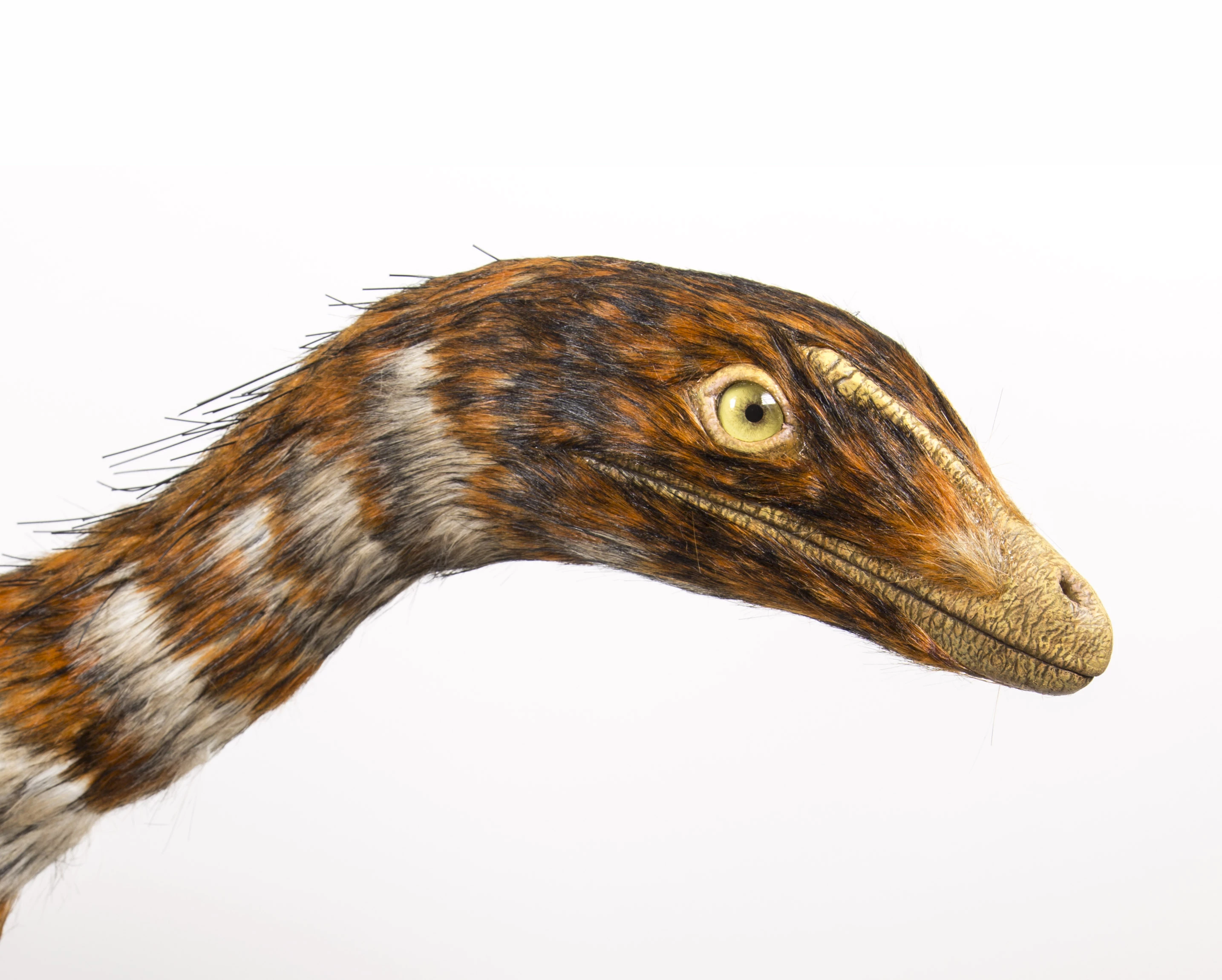
There is one thing that is entirely new to the gallery, something which will be obvious immediately to said 6-year old dinosaur enthusiast (and those of any other age, too): the new Welsh dinosaur now has a permanent home as part of our dinosaur display. A life-sized artist’s impression, feathers and colours and all, is now peeking from the early Jurassic back to its Triassic cousins. It is truly magnificent and inspiring, and actually one of the first models to represent the latest research that these kinds of dinosaurs were clad in feathers. The enthusiast in myself wants to add pathos to this announcement, which is difficult to express in a blog. Hence I’ll stop myself right here and simply invite you to come and see it.

Oh, one more thing. While working in the displays in the past two weeks we found countless sweet wrappers, discarded chewing gums and bits of sandwiches and apples in various hidden corners. These kinds of things encourage pests which we don’t want in the museum any more than you would want them in your house. We have the restaurant, café and schools sandwich room where you are welcome to eat, and there are bins in the Main Hall before you enter the galleries. We would be immensely grateful if you didn’t take any food into the galleries.

Find out more about care of collections at Amgueddfa Cymru - National Museum Wales here.