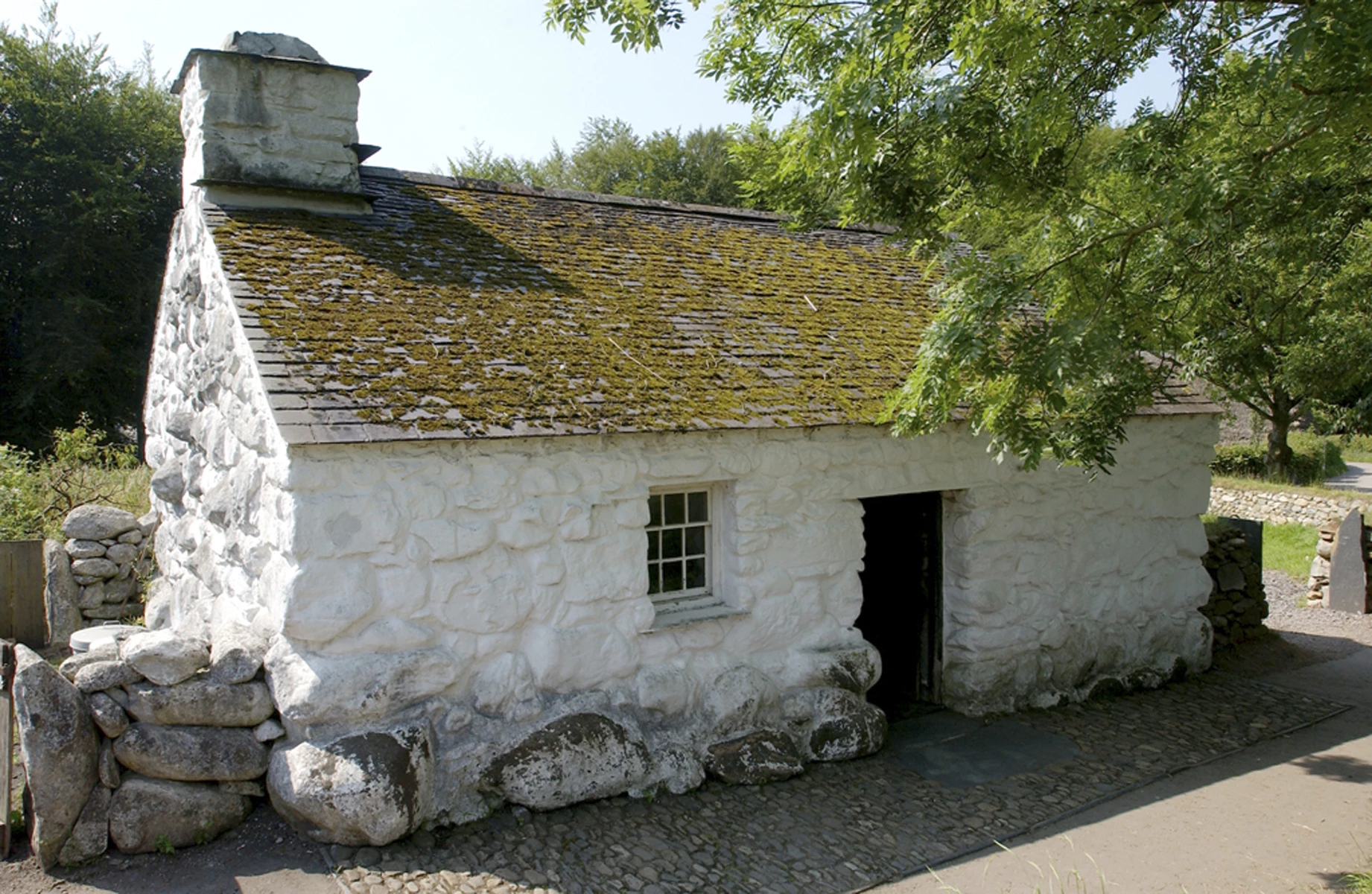
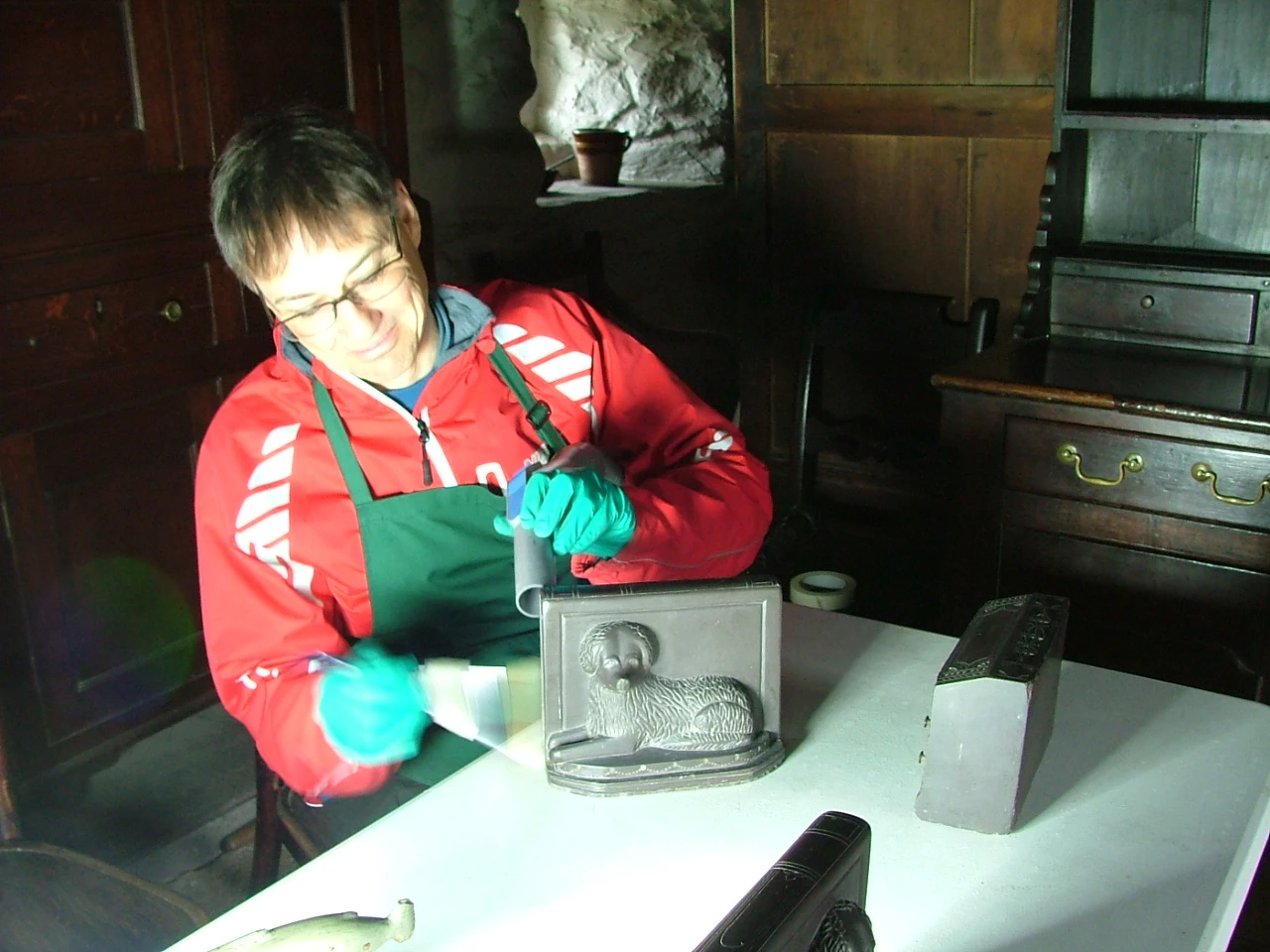
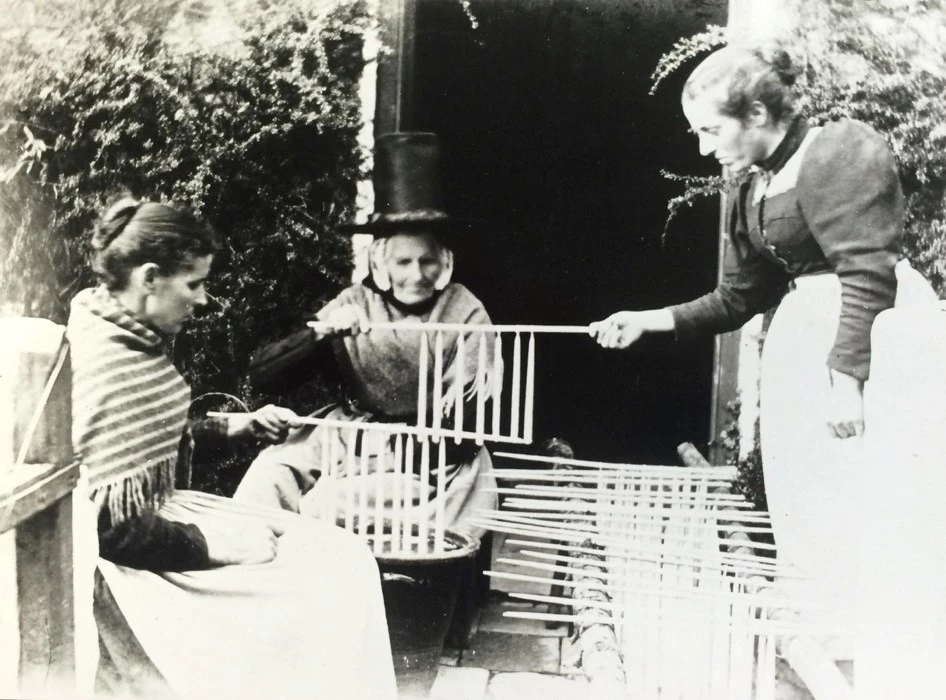
Don't worry no violence was involved. It was the turn of Llainfadyn this week, our quarrymen’s cottage from Gwynedd, to receive a clean and make over from our Historic Interior and Conservation Volunteer team. It was a big task so thanks to everyone involved. This included stripping the beds and giving everything including the feather mattresses a good airing and beating to remove a winter's worth of dust and dirt. As long as the textiles are strong enough this is still a very effective method of removing grime without the aid of modern appliances.
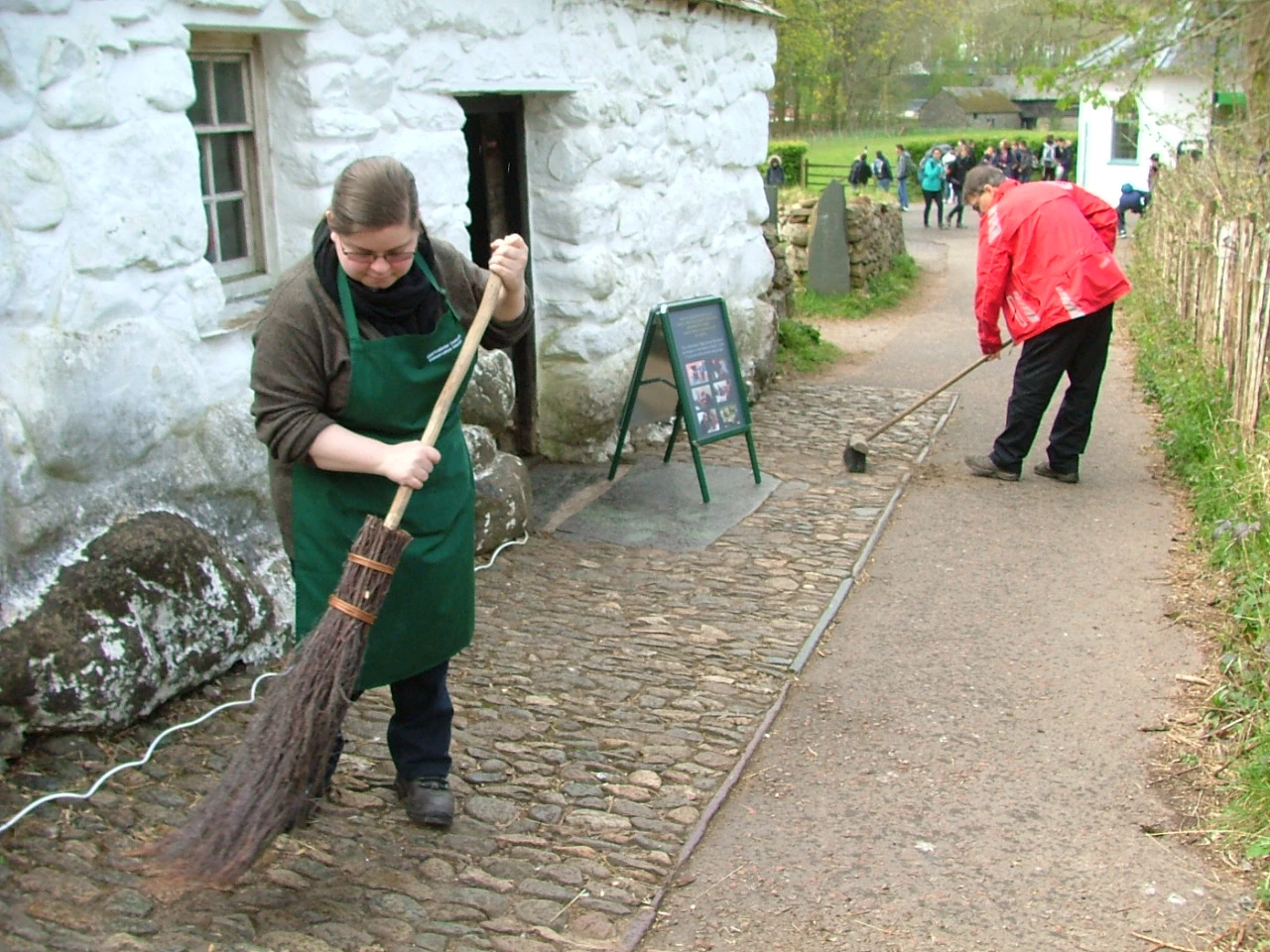
We also held a competition between a modern broom and a traditional one made from hazel twigs (that all important witches’ accessory at Halloween). To help protect the collections on display it's important we try and reduce the amount of dust and dirt being brought into the houses by our thousands of visitors each year. Our first line of defence to achieve this is the cobbles outside, these help dislodge the grit and dirt from peoples' shoes before they even enter the building, but for these to work the cobbles need to be clean and not clogged up with dirt. So one of our first important tasks was to clean the stones outside.
So which broom won? The traditional of course, with its long twiggy brush it was the best at dislodging the dirt from between the cobbles. This job would certainly have been an everyday task for most households in the past.
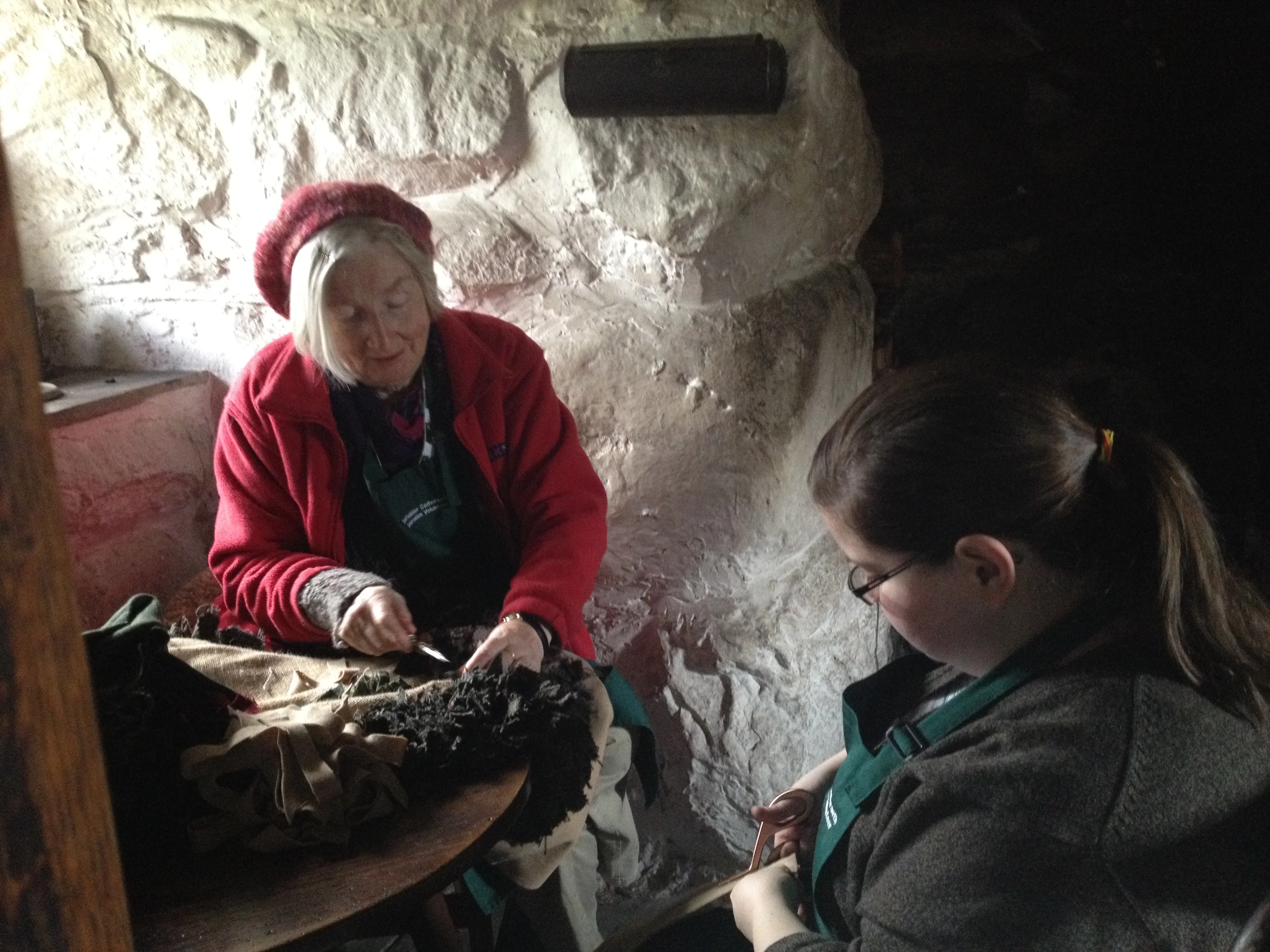
Our second line of defence to keep the dust down is the rag rug, often found in cottages of this period. These were made from scraps of material or worn out clothes and blankets, so as well as providing much needed comfort and colour they were great at trapping dirt. They could then be picked up, taken outside and beaten with a carpet beater to remove the grime. We are currently making one for Llainfadyn, unfortunately the odd hail storm meant that Jane and Emma had to find seats by the open fire to carry on their work.
As usual in this monthly blog post I’d like to share with you some of the objects that have been recently added to the industry and transport collections.
The first object this month is this rugby shirt with a ‘Tower Colliery’ badge. It was worn in the 1992 British Coal Cup Final. The donor was working in Taff Merthyr Colliery at the time, and took part in the 1992 Final in which Tower Colliery won. At the end of the match he swapped his Taff Merthyr Colliery RFC shirt for this Tower Colliery one.
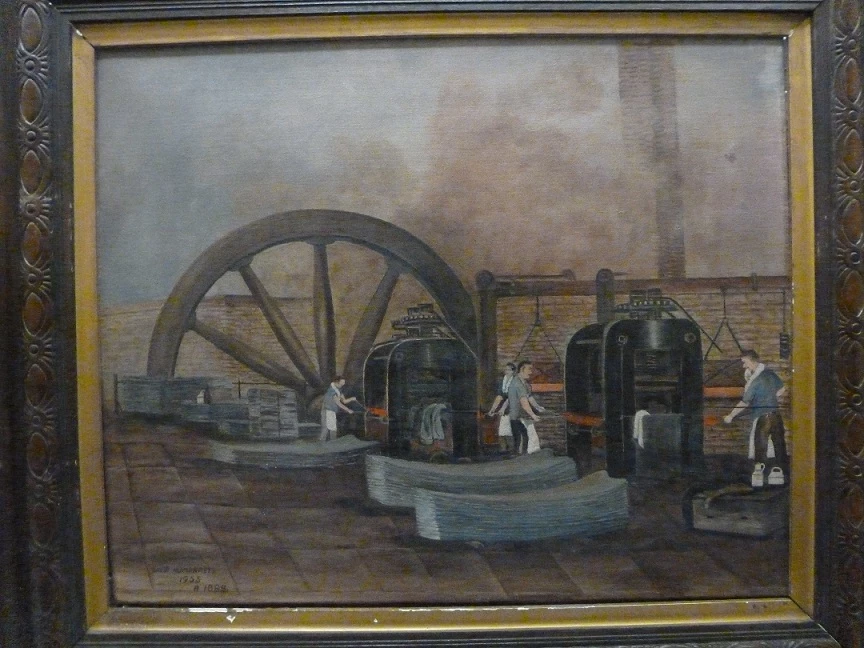
Also, this month the museum was donated two paintings of Pontardawe Steel, Tinplate & Sheet Works. These were painted in 1955 by local amateur artist David Humphreys (born 1882), who had been employed in the works.
“Bar Mill” depicts the roughing stand of the steelworks bar mill, whilst “Hot Mill’s” depicts part of the sheet mills. In both paintings the artist has carefully recorded the working positions of the rollermen and the tools and features of the mill environments, such as the racked bar-turning tongs and cabin on the left of “Bar Mill”, and the tea cans (‘sten’) and jackets in the right foreground of “Hot Mill's”. Such attention to detail to the plant and environment is a distinctive hallmark of an industry ‘insider’ recording scenes he was intimately familiar with.
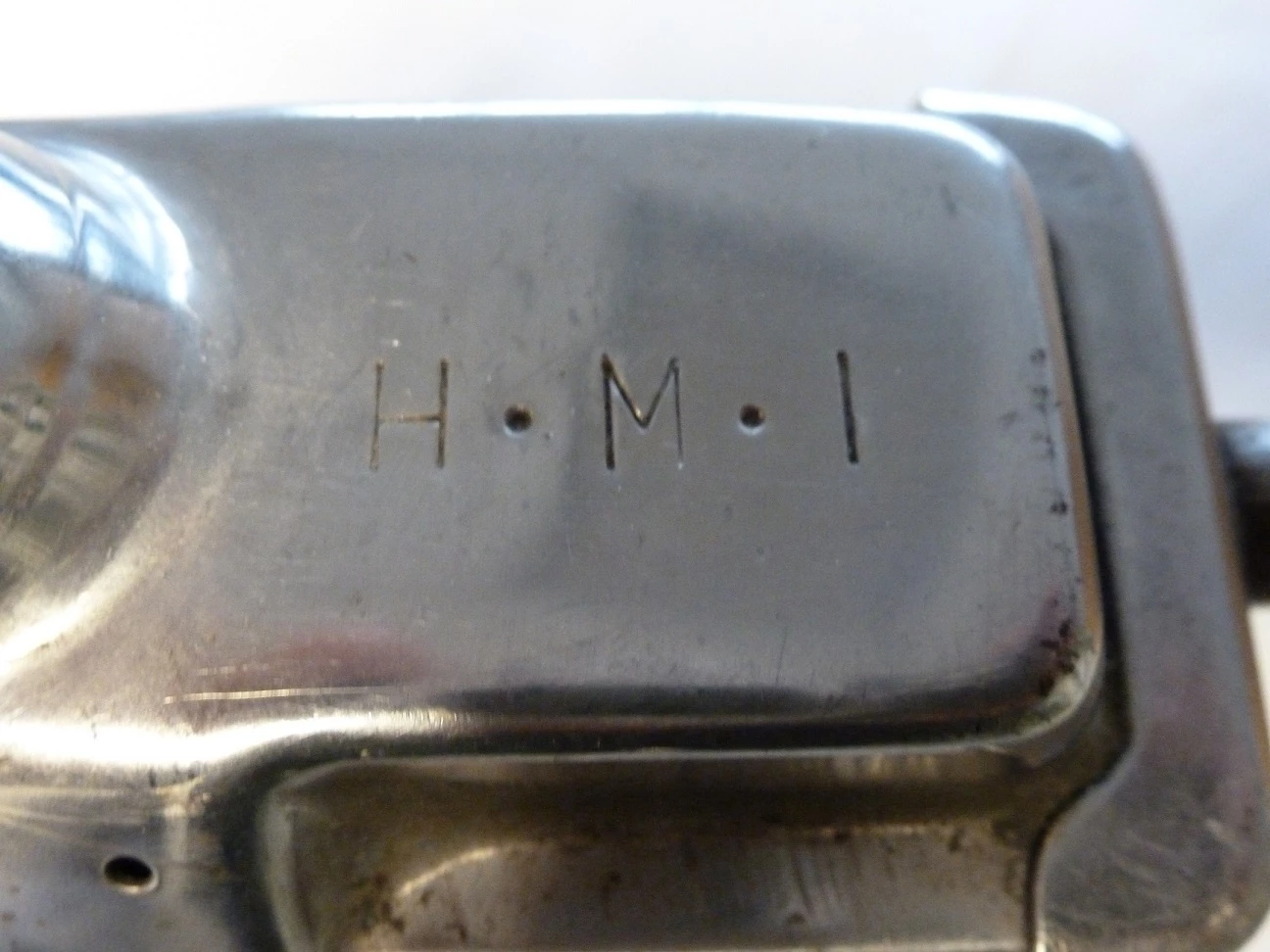
This electric cap lamp was manufactured by Oldham & Son Ltd. in about 1995. It is a standard coal-mining specification cap lamp, but is distinguished by being specifically inscribed “H.M.I” (Her Majesty’s Inspector (of Mines)) on the metal battery lid. It was owned and used by one of the South Wales Inspectors of Mines between 1996 and c.2004 during the course of his work.
Amgueddfa Cymru holds by far the largest and wide-ranging Welsh-interest share certificate collection held by any public museum. The collection ranges across railway and maritime transport, coal mining, the mining and smelting of metals, general industry, and service industries (finance, leisure, consumer products, etc.).
The museum is actively collecting in this field, and this month we have added two further examples to the collections.
The first is for the The Gwendraeith [sic] Valleys Lime Coal & Railway Co Ltd. This company was formed in February 1868 to develop the limestone and coal deposits in the lower Gwendraeth Valley. The company wanted to develop limestone quarrying and lime burning, and to acquire the existing railway which it intended to extend into the coalfield on the south side of the valley. However only 185 shares were subscribed to and with insufficient capital the company was wound up in December 1869, having achieved nothing on the ground. This certificate is a good example of a number of companies that tried unsuccessfully to develop the anthracite area of the south Wales coalfield.
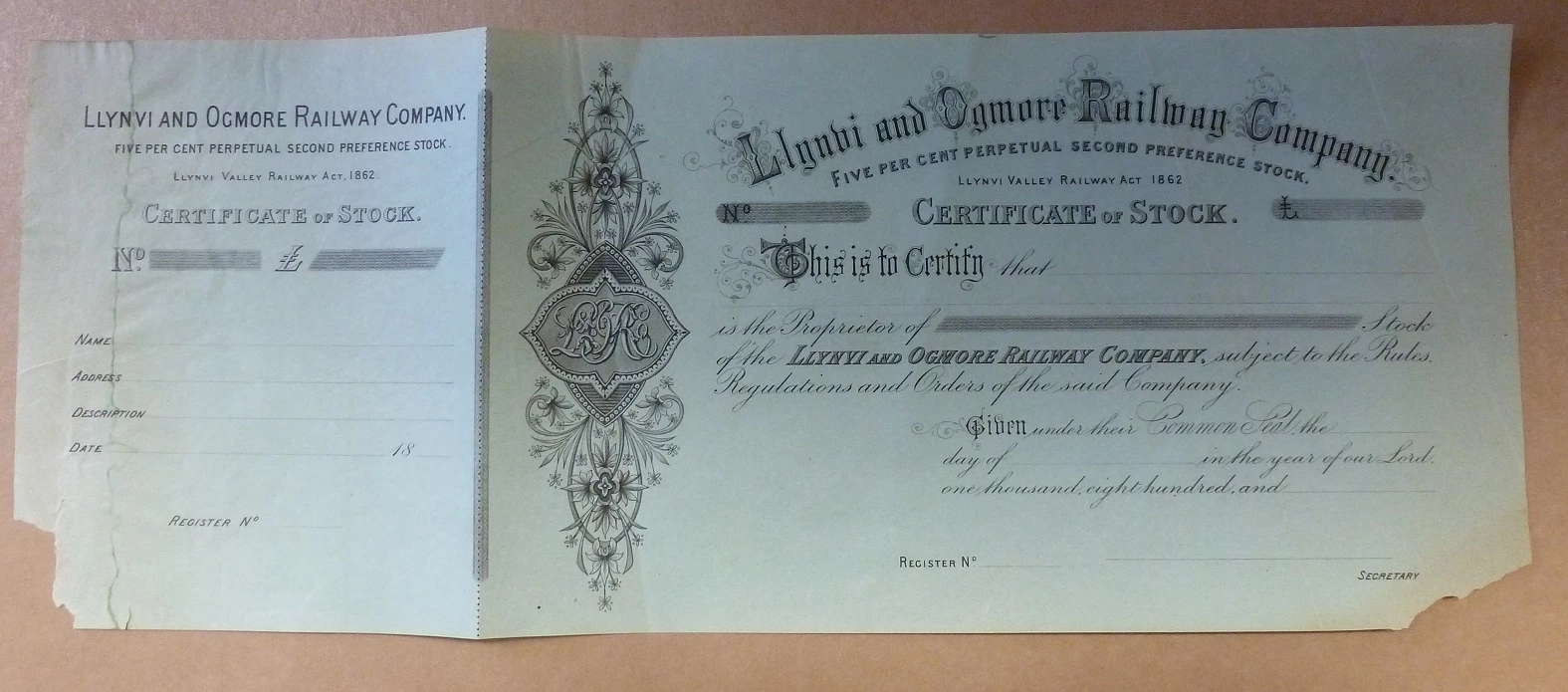
The second certificate is for the Llynvi & Ogmore Railway Company. This company was formed in 1866 to amalgamate the broad gauge Llynvi Railway Company of 1846 and the standard gauge Ogmore Valley Railway of 1863. Both companies’ railways were focussed on Porthcawl Harbour and both were dominated by the Brogden family, Lancashire industrialists who developed the Maesteg iron and coal industry and who expanded dock facilities at Porthcawl. The company was managed by the Great Western Railway from 1873, and eventually absorbed by the G.W.R. in 1883.
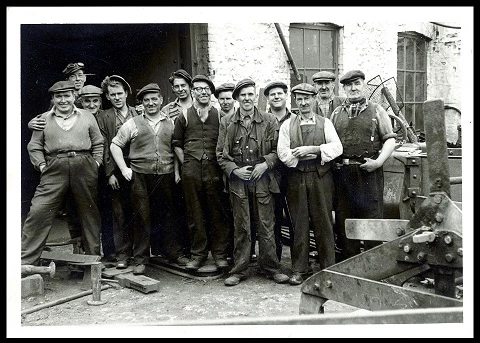
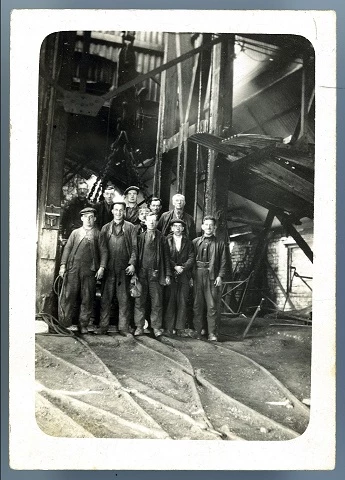
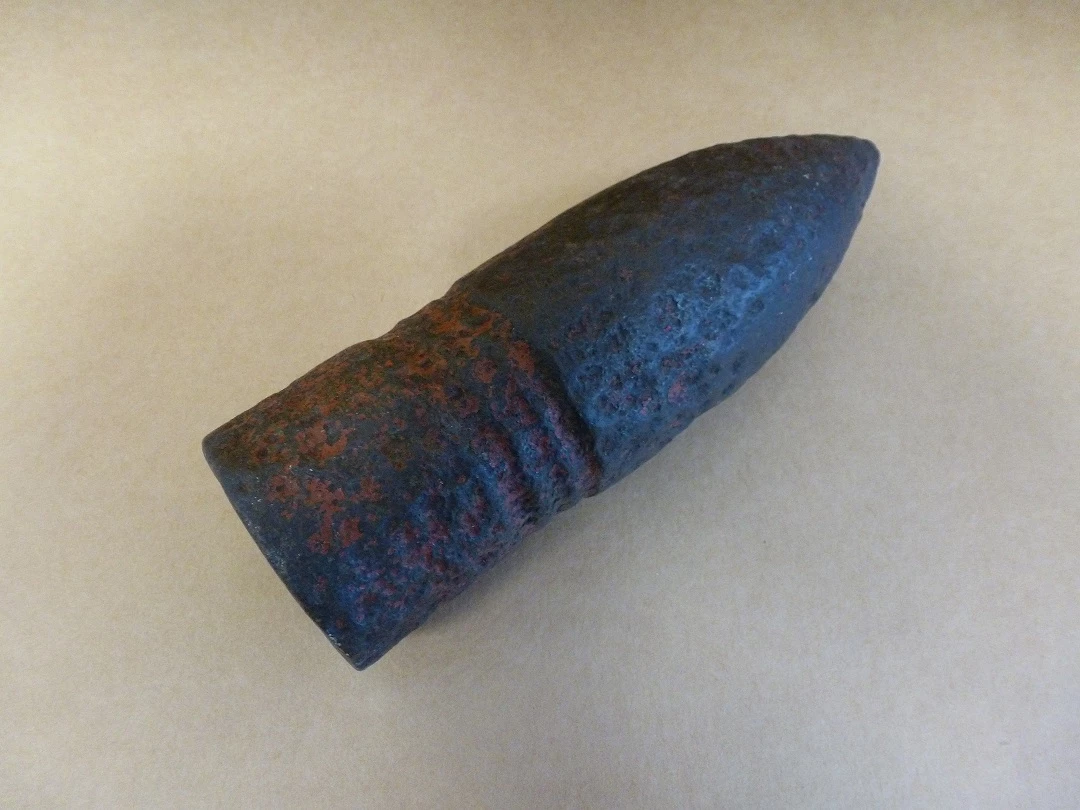
This object is a cast iron artillery round made in Blaenavon steelworks in the mid 19th century. Surplus ones were re-forged for bridle chains on colliery headgears. The chains can be seen in the last photograph of the three below showing blacksmiths at Big Pit in about 1950.
Mark Etheridge
Curator: Industry & Transport
Follow us on Twitter - @IndustryACNMW
Amgueddfa Cymru holds a large collection of material relating to the First World War. Many of these objects from the industry & transport, and social & cultural history collections can be viewed on this online catalogue. This catalogue was created to provide access to this collection of material, especially important during this period of commemorating 100 years since the First World War.
Some of the more poignant objects relate to those who lost their lives in the War, and among these are a number of Rolls of Honour. These either commemorate those who lost their lives, or commemorate both those who served, and those who lost their lives.
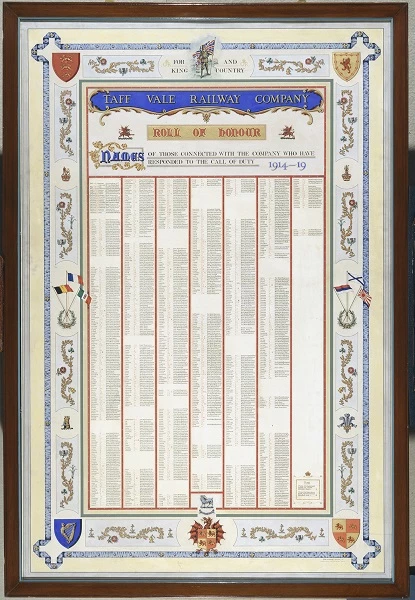
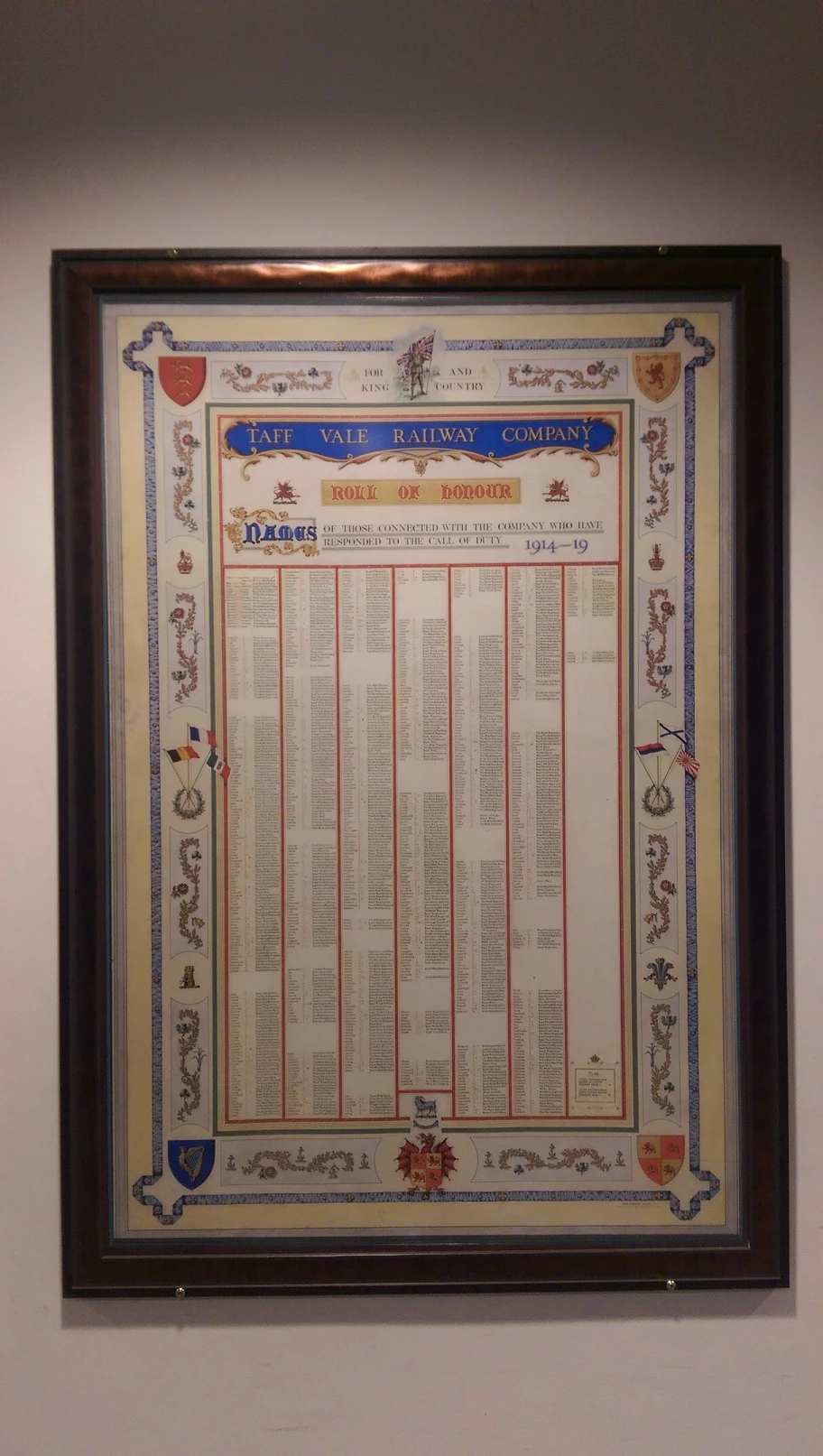
In the industry & transport collection is this very large (it measures 190cm x 130cm) framed and glazed illuminated Roll of Honour. It lists all those staff working for the Taff Vale Railway Company, who served and lost their lives in the First World War. The sheer numbers of staff mentioned shows how the war affected companies such as the T.V.R. and shows the tragic loss of life.
The Roll of Honour was drawn in the engineer’s office of the Taff Vale Railway at Cardiff by Ivor P. Davies. The alphabetical list details all men who served and also includes their regiment. Names are also marked to indicate those who died in action and those who died of other causes.
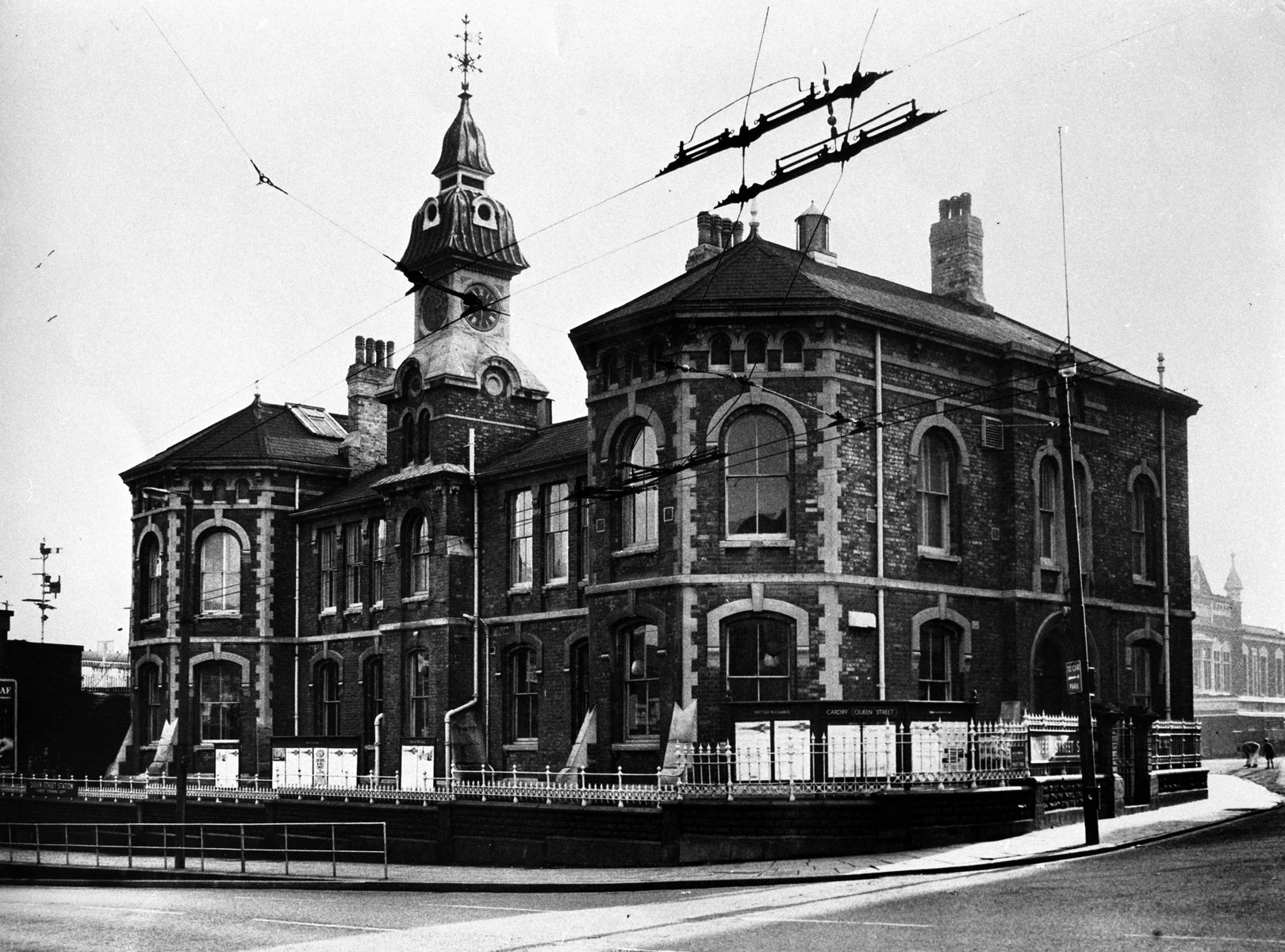
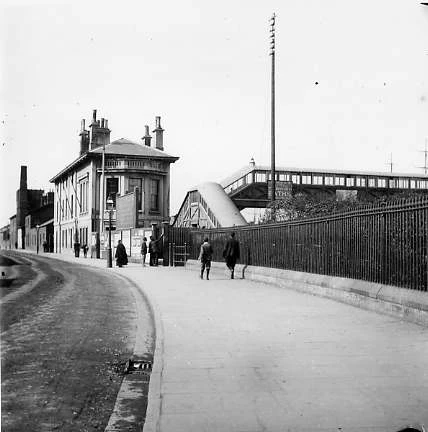
The Roll of Honour originally hung in the T.V.R. offices, in a building located next to Queen Street Station. Presumably it hung there until the offices were demolished in the 1970s during the rebuilding of Queen Street Station. In 1989 the Roll of Honour was acquired by Amgueddfa Cymru, and it displayed in the Railway Gallery, in a building next to Bute Road Station (now Cardiff Bay). This was an appropriate home as it was displayed in a very historic building originally built as the head office for the Taff Vale Railway Company in the 1840s. This building is still standing, though in a poor state of repair.
It is important that this Roll of Honour be displayed during the commemorations. We were therefore pleased to work with staff at Arriva Trains Wales in fulfilling this. We were able to provide a high resolution digital copy, which allowed them to replicate it. The replica has now been placed on display in the newly revamped Queen Street Station, where it can be viewed by thousands of travellers passing through.
Mark Etheridge
Curator (Industry & Transport)
Follow us on Twitter - @IndustryACNMW
Fern Thomas is one of the supporting artists currently working in St Fagans with Nils Norman. She has been undertaking research which feeds into the design of the play area. Fern is an artist based in Swansea and is interested in the connections between history, folk magic and ecological futures.
Sometimes a building or a place seems to hold an echo or a trace from its past. It is not something that is tangible, but rather a feeling that can be sensed or imagined into. Many of the buildings at St Fagans possess this quality or phenomena. Alongside the age-appropriate furniture, it is perhaps the darkness and firelight of the stone cottages or farmhouses that evoke the past, showing us how the shadows fell and danced across the stone walls, how the glow of the fire would have lit up the faces of those who lived there.
I have had a similar experience to this whilst researching the archives in these recent months. As artist in residence I have had the privilege of exploring St Fagans archives and collections whilst I search for objects, patterns, customs, stories and moments from our Welsh history that could inform the design of the new play area at St Fagans by artist Nils Norman. The play area is intended to reflect the buildings and wider collections of St Fagans, offering the opportunity during this research stage to explore all aspects of the collections; from agriculture to needlework, as well as the collections associated with play.
The criteria of the brief has created an interesting framework in which I view and experience the archive, where every item or photograph I encounter invites me to question if this object from the past could be reinterpreted by Nils Norman as an object of play for children to engage with at the museum. This process has been heightened and informed by observing my one year old as he begins to interact with space, scale, and the alternative use of everyday objects!
In my research I have found myself most drawn to the photographic collections where, alongside documentation of objects on display or housed in the stores, are photographs of people captured in their everyday lives; be it collecting hay, hanging out the washing, attending agricultural shows, ‘beating the bounds’, playing at amateur dramatics, or as by-standers at a funeral or historical event. Whether posed or captured in the moment, all of these images offer a window into life unfolding.
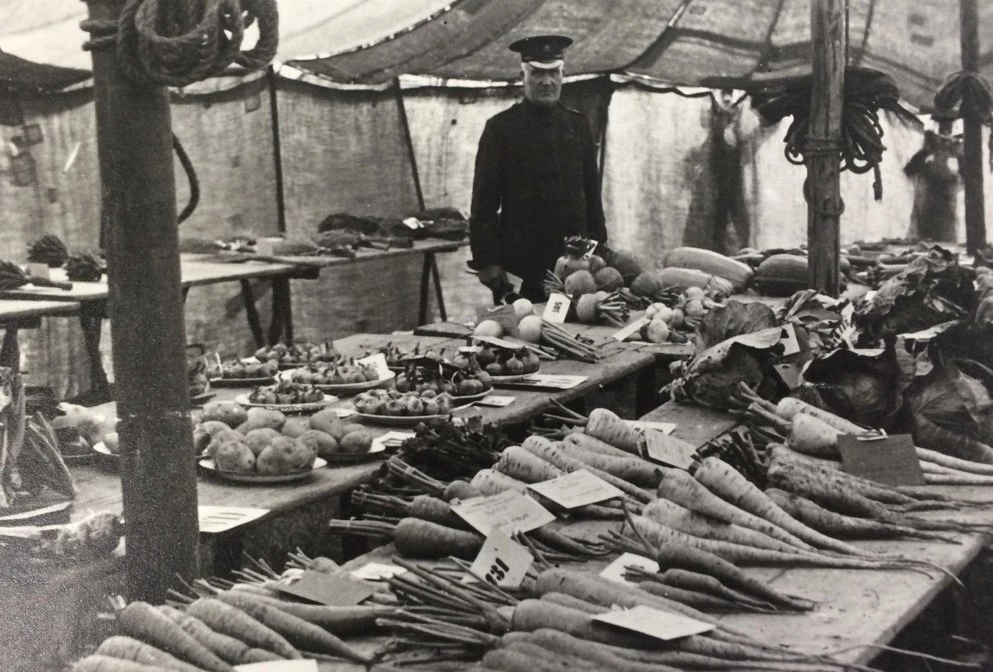
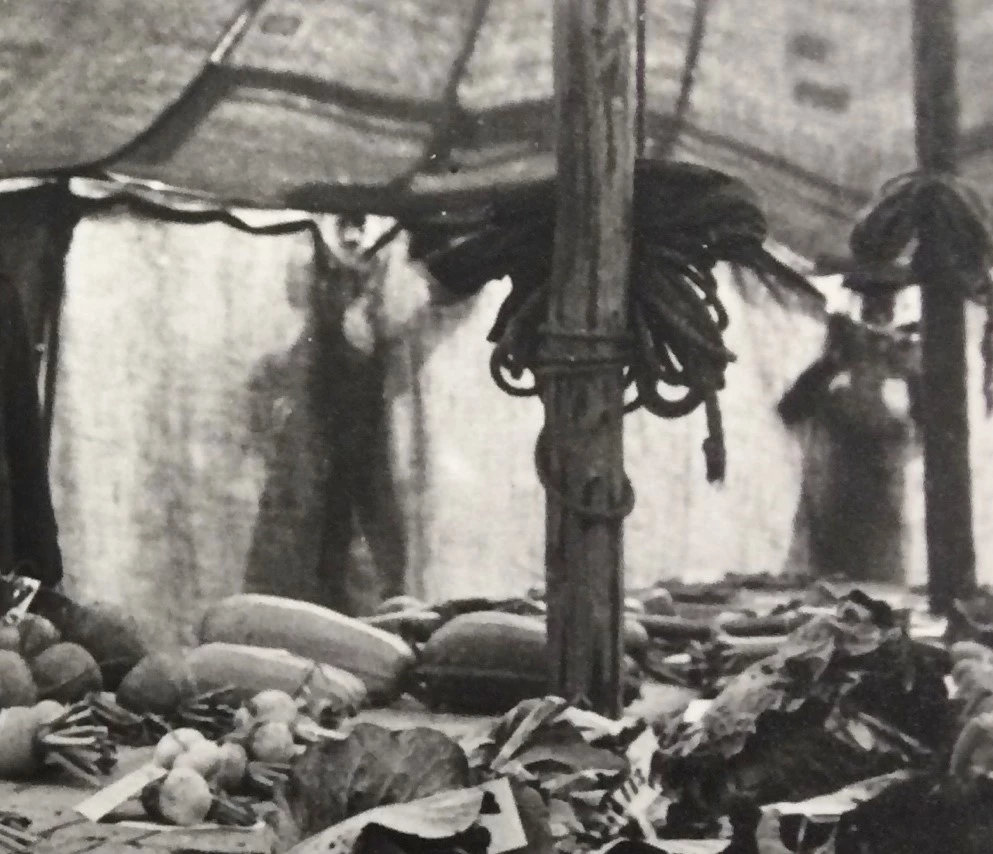
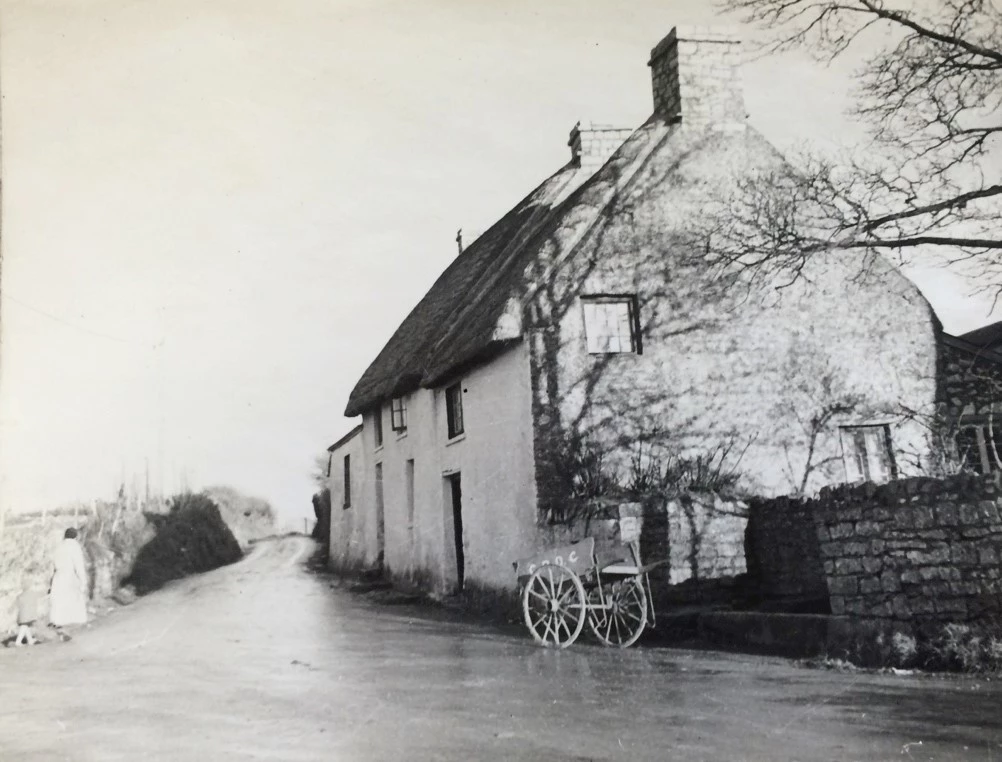
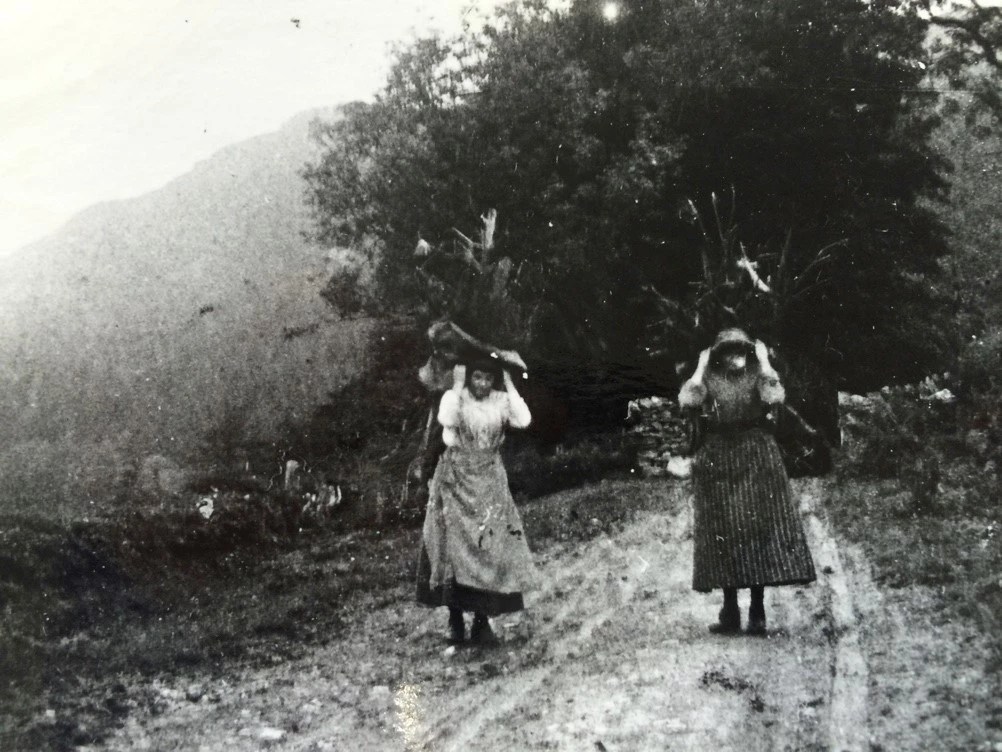
As I continue to look through the filing cabinets image by image I discover that there are these hauntings. Much like the echo from the buildings, some of the images hold an evocative quality, a presence that can be felt that transcends the elapsed time between then and now. Young women in the field stare out at me, a crowd gathers at a mill after a fire. Then there are the incidental moments within the photographs, details that open up a set of questions. Who are those boys peeping though the back of the tent at the vegetable show? Where are the (presumed) mother and child in the corner of the image walking to?
If you are a daydreamer it is easy to wander off. Narratives unfold and questions are sparked. What are they doing there? Is that a relative of mine? Could it be an ancestor? Surely we have the same nose. I find myself becoming aware that I am looking for my own past as I learn more about the nations collective history.
Women of the archives have become a particular fascination over the past few weeks. I have encountered them in their arduous domestic roles as butter makers, bread bakers and cow milkers. There are also photographs of women in the landscape, carrying firewood or collecting water from a well, inviting me to consider the connection to the land that was inherent in everyday life that I perhaps do not experience.
There is a section in the photographic archives dedicated to ‘Dyn hysbys’ (wise man), this would have been a local man offering remedies, healing and solutions to everyday problems. I haven’t (so far) come across a similar category for women which would perhaps be ‘gwrach’ (witch) or wise woman. As I search I begin to imagine what is not present in the archives - the undocumented actions, beliefs and role of women who were of the land; who knew how to make a healing poultice for a burn or bite (though there are some excellent hand written remedies from women across Wales collected by researcher S. Minwel Tibbott during the 1960’s), who worked with the seasons or conversed with the bees. Witches perhaps, but not witches with pointy hats (though they are present too!) or ‘hags’, but women who had a relationship with nature, and who could offer us an interesting view on our modern day disconnection from the land.
Often in the archives women are cited as ‘the wife of so and so’ or ‘gwraig’ and in my very small knowledge of Welsh language I try to make the connection between the two words ‘gwraig’ and ‘gwrach’. I discover (for myself at least) that, according to the Geiriadur Prifysgol Cymru, in the middle ages the two words had a blurred meaning, and that in some instances ‘gwrach’ could simply mean ‘old woman, mother’ which for me suggests every woman was a sorceress, healer or worker of magic!
As I continue then to look upon every image within the filing cabinets I find myself asking; ‘where are the witches of Wales?’ and could there be value now in remembering the shared meaning in the words ‘gwraig’ and ‘gwrach’?
It’s been a few weeks since I wrote my last blog about interviewing Mel and Rhona Rees, former landlords of the Vulcan pub. Our aim with the Vulcan project over the next few months is to capture the experiences and memories of the people who knew the Vulcan, with the interviews eventually being displayed in one of the redeveloped galleries.
Since the last interview, we’ve been out again hearing about a very different aspect of the Vulcan’s story and history, the pub’s closure and the campaign to save it. The Vulcan was due to close in June 2009 to make way for a multi-story car park and flats which resulted in the formation of the ‘Save the Vulcan Campaign’.
To capture the story, Dafydd Wiliam and I interviewed Rachel Cable, the ‘Save the Vulcan’ campaign manager. We met Rachel at the National Assembly in Cardiff Bay, where 7 years ago, around 50 campaigners presented a petition with over 5,000 signatures to save the pub to Assembly Members.
Among the famous names to back the 5,000-signature petition were James Dean Bradfield, of Manic Street Preachers, actor Rhys Ifans and sports presenter John Inverdale.
Rachel spoke about her first visit to the pub in Adamsdown and how she fell in love with its old fashioned décor and friendly punters and landlady. To Rachel and many others, this was a pub that needed to be saved. As part of the campaign they started a petition, made an application to CADW to get the Vulcan listed, designed and sold Save the Vulcan t-shirts and organised events at the pub such as literary nights and even a Star Treck party!
Rachel also spoke of the huge success of the Save the Vulcan blog and facebook page which helped attract support and also resulted in wider media attention.
Due the determination and hard work of the campaigners an agreement was reached in 2009 for the Vulcan to remain open for a further three years. The campaign continued during these years, but unfortunately they were to lose the battle, and the last order was called on Friday 4th May, 2012.
You’ll have to wait until the new galleries open to watch the final interview, but until then keep an eye out for more blogs about recording the voices of the Vulcan!
If you or somebody you know have stories or objects related to the Vulcan, we’d love to hear from you – please leave a message in the comments box below.
The Vulcan Hotel is one of the museum's on-going building projects. Read more here.