The last year has been a busy one for the Department of Natural Sciences on the front line against invasive non-native species (INNS) in the UK.
INNS are introduced (or "alien") species that can spread and cause damage. Some INNS, like Japanese Knotweed and the Grey Squirrel, are all too familiar. Others, like most invertebrates, are unidentified and obscure when they first arrive.
It is often down to taxonomic specialists like us to identify these newly detected animals – with the help of museum collections – and to explain how they can be recognised.
In the last 12 months our Invertebrate Biodiversity team helped discover several more species new to the UK, and reported these in the Journal of Conchology and Aquatic Invasions. These are detailed peer-reviewed research papers, but such publications are not merely useful for specialists. They are referred to by agencies, policy-makers, and the public concerned about the spread and impacts of INNS in the UK and throughout Europe, as the range of other organisations we worked with shows.
The relevant specimens are accessioned at the Museum for future reference, and help ensure the national collections stay up-to-date with the changing fauna of Wales.The discoveries also make great stories about the surprises Britain’s wildlife still holds in store. We just hope that some will have happy endings!
1. Rogue Alsatian loose in Caerphilly
Aberbargoed naturalist Christian Owen spotted something weird during a meeting of the Glamorgan Fungus Group near Wern Ddu Claypits, Caerphilly (a noted geological and industrial site). Crawling under moss in the forestry plantations were several strange, small creatures, like overweight snails poking out of shells that are several sizes too small.
Using the Museum’s collections, we identified the species as the “Alsatian Semi-slug” Daudebardia rufa. This is a central European mollusc that has never been seen in the UK before. Despite being rather cute, it could be a nuisance since it feeds on other, wood-decaying invertebrates. We obtained forestry data for the area from partners from Natural Resources Wales, and our visits to the area so far suggest that the species is associated with certain conifer stands only.This story was featured in the Caerphilly Observer newspaper on 19 February 2016.
Reference: Owen, C, Rowson, B & Wilkinson, K. 2016. First record of the predatory semi-slug Daudebardia rufa (Draparnaud, 1805) from the UK (Eupulmonata: Daudebardiidae). Journal of Conchology 42(3) 119-121.
2. Sicilian Slug reaches Dublin and Swansea
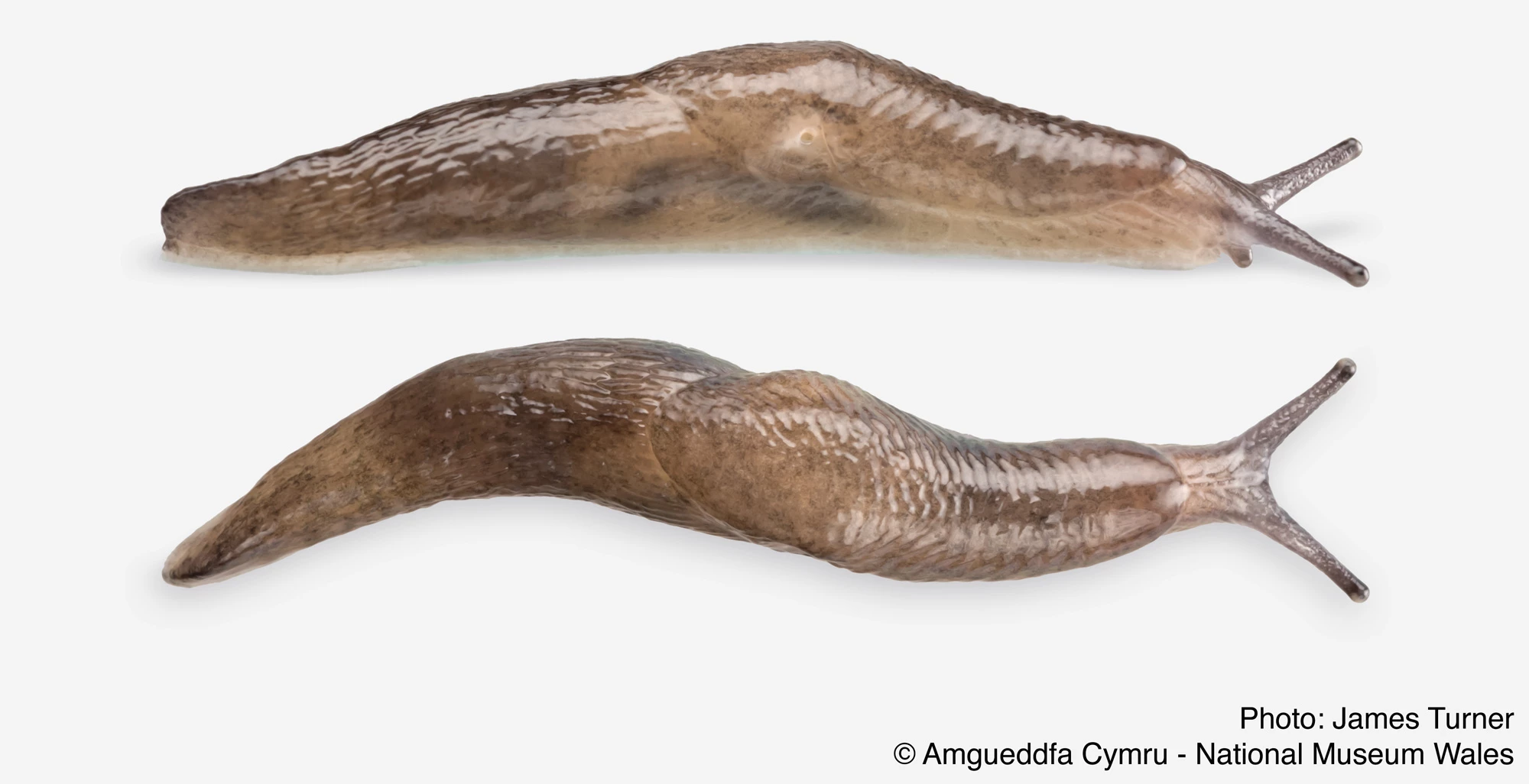
We discovered the Sicilian Slug Deroceras panormitanum as new to Britain in central Cardiff in 2012. It is evidently rare, so we were surprised to find a large population during a night-time survey in Swansea in April 2015. They were infesting flowerbeds in Cwmdonkin Park (famous from Dylan Thomas’ “The Hunchback in the Park”), which we were investigating as part of a study with Swansea University and Bristol University.Our partner in the Conchological Society also found the species among plants at a garden centre in Dublin, the first record of this species in Ireland. Searches at Welsh garden centres have so far proved negative, but this species now seems very likely to spread.
Reference: Rowson, B, Anderson, R, Allen, S, Forman, D, Greig, C & Aziz, NAA. 2016. Another wave of invasion? First record of the true Sicilian Slug Deroceras panormitanum sensu stricto from Ireland, and another from Wales (Eupulmonata: Agriolimacidae). Journal of Conchology 42(3) 123-125.
3. Piggy-backing American worms in Abergavenny river
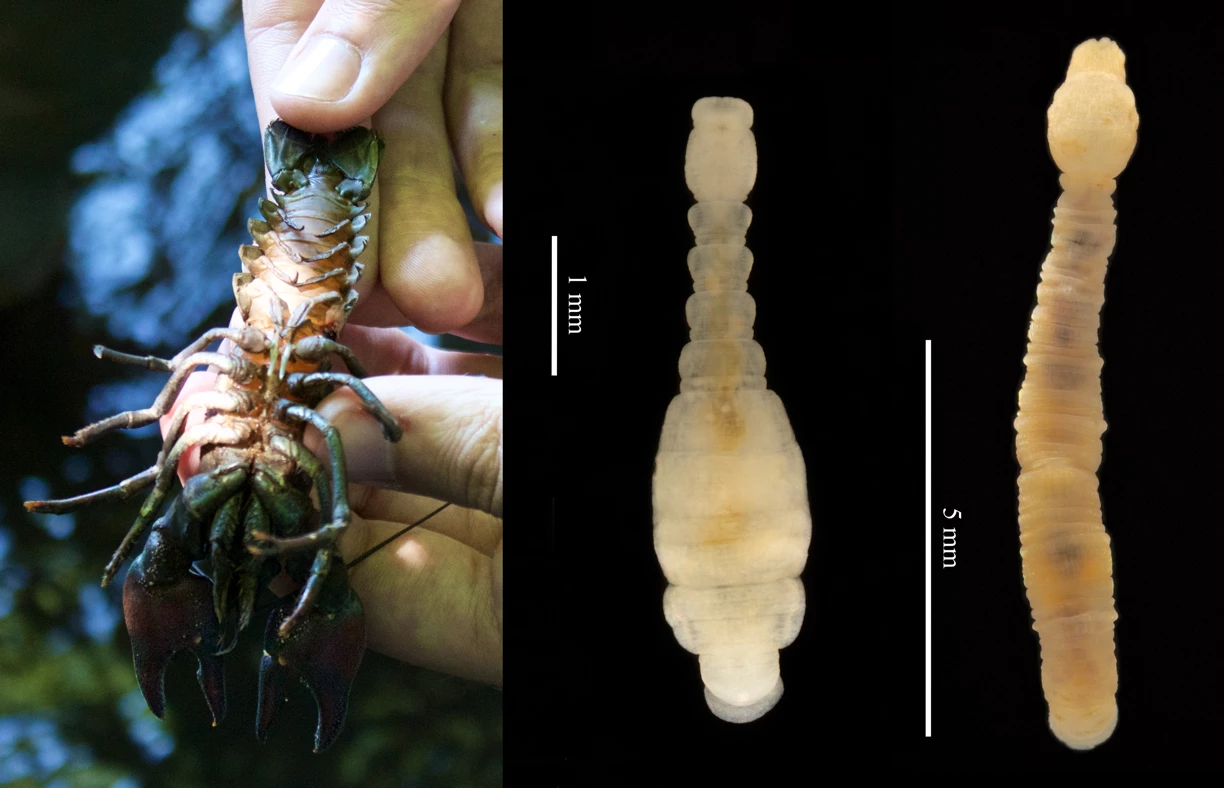
The introduced and prolific North American Signal Crayfish Pacifastacus leniusculus is a major threat to our native White-clawed Crayfish Austropotamobius pallipes through transmission of crayfish plague. Now, a new potential danger has been found. Joanna James, a PhD student at Cardiff University, discovered two species of crayfish worm (small leech-like annelids) living on the claws and carapaces of signals in the River Gavenny. These were identified in collaborative research with the Museum and a paper published in the journal Aquatic Invasions. University research is continuing into the impact these worms could have on invasive and native crayfish populations.
Reference: James, J, Cable, J, Richardson, G, Davidson, KE & Mackie, ASY. 2015. Two alien species of Branchiobdellida (Annelida: Clitellata) new to the British Isles: a morphological and molecular study. Aquatic Invasions 10(4) 371-383.
4. Big winter storms cast up trans-Atlantic migrants
Old buoys, fishing bait buckets and plastic spools double as rafts for many American invertebrates washed ashore on southwest coasts of the UK in recent years. UK Coastal Wildlife and APhotomarine often send images or specimens to the museum for identification. The newly-arrived bivalves had crossed the Atlantic inside buckets, or attached to the outside with byssus threads (as our native mussels attach to rocks).
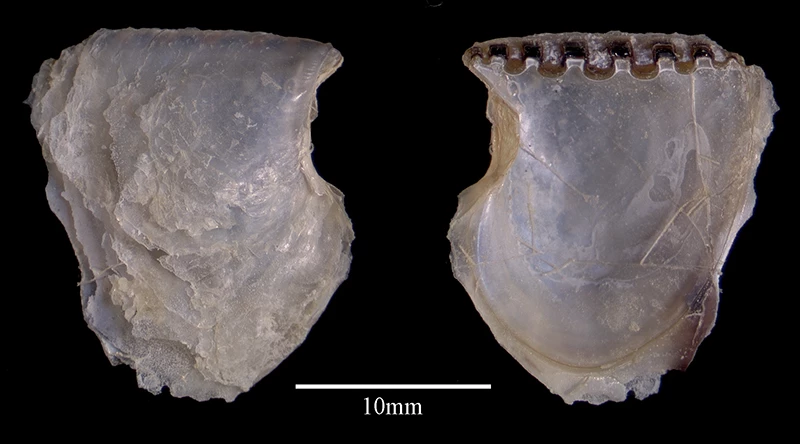
One of these hitchhikers is considered an INNS in Brazil, where it outcompetes local bivalves for food and space. The Bicolor Purse Oyster Isognomon bicolor is native to the southern United States and parts of the Caribbean. Our current sea temperatures are slightly too low for it to reproduce, but if they continue to rise this and perhaps other American molluscs will need to be closely monitored.
Since reporting these finds in Journal of Conchology last year, further discoveries of yet more American species have been made and sent for identification. We thank the beachcombers who brave our shores every week to hunt for these potential invasives.
Reference: Holmes, AM, Oliver, PG, Trewhella, S, Hill, R & Quigley, DTG. 2015. Trans-Atlantic rafting of inshore Mollusca on macro-litter: American molluscs on British and Irish shores, new records. Journal of Conchology 42(1) 41-49.
5. Coconut conceals “shy” stowaways
Cornish writer and beachcomer, Tracey Williams, discovered a beached coconut near Newquay, Cornwall. On closer inspection, Paul Gainey found molluscs inside - small white shells that had bored into the husk. These were later identified by Dave Fenwick as the “Fragile Piddock” Martesia fragilis. They must have floated right across the Atlantic from the southeastern United States and washed ashore after the winter storms of 2013-14.
Notoriously difficult to identify, we searched the extensive shell collection at the Museum for other piddocks. We found that one more lot of the same species had been washed ashore at Galway in the late 1800’s but had been misidentified! Fragile piddocks are related to shipworms and can bore into wood, nuts and seeds, although thankfully are less destructive than their shipwrecking cousins.
Reference: Holmes, AM, Fenwick, D, Gainey, P & Williams, T. 2015. Martesia fragilis Verrill & Bush, 1898 in the north-east Atlantic. Overlooked and a recent new discovery. Journal of Conchology 42(2) 183-187.