Tom Sharpe's Antarctic Diary 2011-12-06

Friday 18 November

It’s just over a hundred years since Captain Scott’s ship, the Terra Nova, sailed from Cardiff for Antarctica.

Scott designated Cardiff the home port of his ship because of the support his expedition received from Cardiff and South Wales. Last year we put together a little exhibition bringing together a range of objects from our collections to commemorate the departure of the expedition on 15 June 1910.

On 17 January 1912, Scott and his four companions reached the South Pole only to find that he had been beaten, by a month, by a Norwegian team led by Roald Amundsen. The fate of Scott’s Polar Party is well-known: all five died on the return journey. But there was much more to Scott’s expedition than the attempt on the Pole. It was a major scientific expedition, studying the geology, biology, meteorology and physics of Antarctica and its glaciers.

We’re planning another exhibition, , opening in January 2012, to look at the Welsh links with Scott’s expedition and the scientific work undertaken on it. We’re part of a national series of exhibitions and events to mark the centenary of the expedition. I’ve been working on this exhibition for some months now, but about four weeks ago my preparations took an exciting turn when I was invited to join a trip to the Ross Sea in Antarctica, with the intention of visiting Scott’s expedition base hut.

We sailed a week ago from Lyttleton in the South Island of New Zealand, the same port from which Scott sailed in 1910. Two days ago, we entered the pack ice of the Ross Sea. Each winter, the continent of Antarctica doubles in size as the sea around it freezes. I’m on a Russian icebreaker. We’ve been following leads - strips of open water between the ice floes - and where necessary forcing our way through the thicker floes. We do this by ramming into the ice, then reversing a few hundred metres before ploughing full ahead into the floe and hopefully breaking through. Breaking our way through the ice feels very much like being in the central seats of a 747 in bad turbulence, but much noisier.

We’ve been making good progress, initially through thin first year ice (formed this last winter) and then into an area of open water called a polynya. But today we’ve slowed. The pack ice we’re in now is much thicker, over a metre thick in places. This is multi-year ice, built up over several winters. At 70oS, we’re now well south of the Antarctic Circle and in continuous daylight. Here the sun will not set for some months.

Some of the ice floes are forced together by the pressure of tides and currents and today we found ourselves caught between two floes. This pressure caused the floes to close behind us, and for a while we were trapped in the ice. Even with all engines on full power, we could neither advance or reverse. But just as we were beginning to decide who we would eat first, the ice floes parted and we were released from their grip!

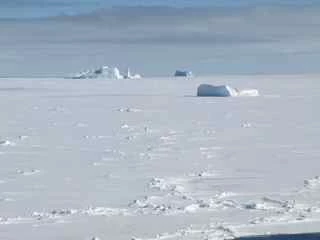
All around us there is nothing but sea ice to the horizon in all directions. The ice surface is not smooth, but broken by the jagged lines of pressure ridges and the occasional enormous tabular iceberg frozen into the pack ice. It looks lifeless. There are no other human beings as far as the eye can see. But life is here. This morning an orca, a killer whale, popped up to take a look at us; minke whales show their fins through the open water of the leads; and crabeater seals bask on the ice floes. Clusters of Adelie penguins rush around on the ice while, in contrast, a stately Emperor penguin stands tall and imperious on the edge of a floe.

There is no environment on earth to compare.

Polychaete research in the Falklands by Teresa Darbyshire - weekend dive report

Yes it was a good sign! The weather this weekend has been what every diver dreams of, light if any wind, flat seas and warm. Do I dare complain that the risk of sunburn was too high having already fallen foul of the strong rays here several times? No, just don’t forget the suncream!


5am was a very early wake up call on Friday but I don’t think anyone regretted it. We headed over to Egg Harbour which, as I am used to now, required a long drive on gravel followed by an off-road track, when one was available, or a general ‘it’s over that way’ decision on driving over unmarked territory. This time however, we were towing a RIB as well, not something you normally contemplate off-road! To be fair though, this RIB is on a double-axled trailer with tyres the same size as the cars. It too seemed to bump happily along and over the rough ground although even the four wheel drive needed help once on a steep slope (photo 1).


We were staying at Egg Harbour house (photo 2), a strange sight as you approach it sitting on its own on the hillside with absolutely no other sign of civilisation around it. Still, it was very comfortable, with its own jenny and water pump for amenities and peat burning aga to keep us warm in the evening.


But what about the diving I hear you ask? The diving was all virgin territory as this area was unsurveyed and new to all there. I’ll admit that the life was not as prolific as at Cochon Island, however the kelp was also not as thick and the bottom was very light. Although the visibility was similar to before, the light made everything seem clearer (photo 3). Most of the dives were on rocky seabeds with the rocks of varying sizes across the sites, some easy to turnover in my hunt for worms some not so. Sometimes turning over a rock produced a surprise, as much for me as undoubtedly for the stunned octopus that stubbornly clung to the rock as it guarded its eggs (photo 4)! Starfish of many different sizes and shapes abound but the pretty picture award went to this whelk (photo 5).


As for the worms there were many different ones for me to collect. I was particularly happy to find this pectinarid (photo 6), a group I had not collected here up to this point. There were several to be found on the dive lying on the seabed which on this dive had lots of sandy sediment between the rocks. This animal builds a very neat cone-shaped and slightly curved shell, shown in the photograph with the animal next to it. On another dive was a different sort of paddleworm to the one I collected around Cochon with very nice colours (photo 7).


As for the other wildlife, we had a brief visit by some Commerson’s dolphins as we arrived at the launching site on Friday afternoon and then on Saturday we had some friendly and some not so friendly sealions (photo 8). The photo also shows just how flat and almost glassy the water was by then. I unfortunately had the not so friendly ones. They were very curious at first although you don’t notice them so much when you’re head down in the sand and rocks, just the occasional flicker in the light as shapes pass above your head. Then you get the nudge. Then you feel something on your head and look up to find a whiskered face in yours. It was when the jaws started nibbling and more around my head that I became concerned particularly as it combined with a bit more force behind it! It was nearly time to come up though and I was happy to do so.


I was also able to do some shore sampling between dives at a couple of sites which kept me busy and all added to a very productive weekend. I was not the only busy one though as all the surveyors had their own reporting sheets to fill in between dives (photo 9). Again, more new sites completed for the team here.


A long drive back Sunday afternoon felt like a shame to all there, with the good weather still persisting. Long may it last (or at least for another week please).

Polychaete research in the Falklands by Teresa Darbyshire - day 18

This was an odd ‘in between’ kind of day. With no car to get around I was very limited in my options of what to do. I got a lift over to the Fisheries department this morning and spent a few hours putting notes together of the animals I’ve found so far and the sites I’ve been to. I also managed to put names to some of species by going through relevant papers I had.


Eventually I put together what pots and chemicals I needed to take with me on this weekend’s dive survey and walked back into Stanley. This was actually very pleasant as the weather at that point was warm and sunny and the wind seemed to be dropping off. On my way I passed a Night Heron (photo 1) at the water’s edge, the first I have seen not sitting still on a nest. Apparently they are generally most active at night, hence the name! All very tranquil.


The low tide was late afternoon today and rather than waste it without a car, I decided to sample a different site along the edge of Stanley. This similarly involved a nice walk along the water’s edge deciding which spot to dig up. By this point, the usual strong wind had become a gentle breeze and the water was unusually still, it all made a nice change.


Stanley is a long, stretched out town, so walking along the front takes a while. There’s not a great deal of change along the shore but I picked a spot just short of the wreck of the Jhelum (photo 2), an old wooden sailing ship condemned and left to rot all the way back in 1871!


This site was slightly different to the one we first sampled over two weeks ago. The stones embedded in a coarse sand were covered underneath in the tubes of the same terebellid worm we found on day 1. Although these worms were the same, there were lots of others in the sand to pick out as well and I am hopeful that some of these may be different. Again, being car-less meant no going back to the lab to look at my catch under the microscope. I had to content myself with sorting them out in the flat instead.


Plans are underway to hire a car next week to get me mobile again for my last week of sampling which will be great. As for tomorrow, we are leaving at 6am for Egg Harbour on the edge of Falkland Sound between East Falkland, where I am now, and the other main island, West Falkland, where we will be diving for the next few days. Hopefully, the still evening is a good sign of the weather we will get.

Bysedd rhewllyd

Bysedd rhewllyd ar fy beic bore 'ma - o ddiwedd mae'n teimlo fel y Gaeaf.

Ddoe oedd y diwrnod cyntaf y gaeaf, ond mae'r hydref ysgafn wedi gadael fy ngardd edrych yn ddryslyd ychydig.

Mae'r hydref wedi bod yn un o'r cynhesaf a gofnodwyd ers 1910. All hyn esbonio pam mae fy rhosod, llygad y dydd a choed yn blodeuo ym mis Rhagfyr? Gweler y lluniau, cymerais ar fy ffôn y bore yma.

Mae rhan gyntaf y rhew yn ymddangos yn yr ardd a fydd yn fwy na thebyg yn rhewi fy mlodau dryslyd. Ochr i ochr, i'r blodau mae rhai coed yn yr ardd yn dangos arddangosfa o aeron yr hydref?!

Oes gen ti lluniau or blodau yn Mis Rhagfyr?

James Pyke Thompson (1846-1897)

James Pyke Thompson, 1846-1897

James Pyke Thompson, 1846-1897

Roedd James Pyke Thompson yn un o gymwynaswyr pennaf Amgueddfa Cymru. Cymynodd ei gasgliad celf i'r Amgueddfa, a rhoi symiau mawr o arian i sicrhau datblygiad Amgueddfa Cymru.


Ganwyd James Pyke Thompson yn Bridgwater yng Ngwlad yr Haf. Roedd yn perthyn i Samuel Browne, oedd yn bartner yng nghwmni melino Spillers, a sefydlwyd gan Joel Spiller yn Bridgwater ym 1829.

Gwelodd diwydiant melino'r DU newidiadau mawr yn ystod y bedwaredd ganrif ar bymtheg. Daeth melinau mawr wedi'u pweru gan stêm i gymryd lle'r hen felinau dŵr a gwynt gwledig, ac fe'u hadeiladwyd yn y porthladdoedd mawr i brosesu'r cyfaint cynyddol o rawn oedd yn cael ei fewnforio i fwydo'r boblogaeth.

Spillers yng Nghaerdydd

Agorodd Spillers felin o'r fath yng Nghaerdydd ym 1854.

Yn dilyn marwolaeth gynnar Joel Spiller y flwyddyn cynt ac ymddeoliad Samuel Browne, daeth y busnes i feddiant y teulu Thompson.

Ym 1864 y dechreuodd James Pyke Thompson reoli Spillers yng Nghaerdydd ar y cyd â'i dad. Ymgartrefodd mewn tŷ crand ym Mhenarth o'r enw Redlands, a byddai yntau a'i wraig Sarah yn chwarae rôl flaenllaw yn eglwys Undebol West Grove.

Casglwr celf brwd

Cyn ymuno â'r cwmni, treuliodd Pyke Thompson flwyddyn ym Mharis, lle datblygodd ei ddiddordeb mewn celf gain. Roedd ei gasgliad yn cynnwys paentiad hynod yr artist cyn-Raphaelaidd, Dante Gabriel Rossetti, Rosamund Deg (a brynwyd gan yr artist am £72-9-0d ym 1885), wyth print ar hugain gan Turner, dros saith deg o luniau dyfrlliw gan artistiaid Prydeinig amrywiol a chasgliad coeth o borslen Caerwrangon, Chelsea, Nantgarw ac Abertawe.

Roedd Pyke Thompson am i'r cyhoedd rannu ei gasgliad. Ym 1887 adeiladodd oriel ar dir ei gartref a'i galw yn Dŷ Turner. Fe agorodd ar 27 Mehefin 1888, ac roedd ar agor ar brynhawniau Sul, pwnc llosg ar y pryd. Roedd Pyke Thompson wedi dadlau ers amser y dylai amgueddfeydd ac orielau cyhoeddus agor ar y Sul, gan ei fod o'r farn y byddai cyfleon o'r fath yn "...dyrchafu meddyliau dyn ac yn cyffwrdd eu calonnau."

Bu farw Pyke Thompson yn Sevenoaks, Swydd Gaint, ar 17 Chwefror 1897 ac ym 1921, daeth Tŷ Turner dan reolaeth yr Amgueddfa Genedlaethol. Yn ei ewyllys, cymynodd ei gasgliad celf, oedd erbyn hynny yn cynnwys llun dyfrlliw mawr gan Turner o Briordy Ewenni, a swm o £3,000 i Amgueddfa Caerdydd; trosglwyddwyd y rhain yn ddiweddarach i'r Amgueddfa Genedlaethol Newydd.

Caiff ei haelioni ei gydnabod yn enw Oriel Pyke Thompson yn Amgueddfa Genedlaethol Caerdydd, lle mae detholiad o'i gasgliad porslen yn dal i gael ei ddangos heddiw. Mae gweithiau eraill o'i gasgliad yn cael eu dangos yn orielau celf yr Amgueddfa hefyd.

Cysylltiadau

Ffotogallery, Turner House