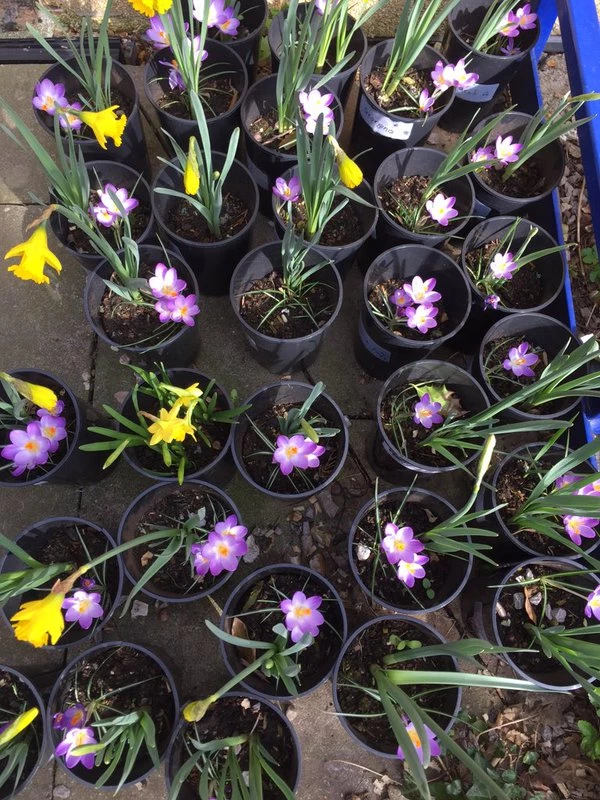
There have been lots of comments about the warmer weather we have had over the last week. The MET Office reported that Thursday the 17th of March was the warmest day of the year so far with temperatures reaching 17 degrees. Silverdale St. John's CE School commented that “Thursday was the hottest day since December”. Many of you also made a connection between the warmer weather and your plants at long last coming into bloom!
Ysgol Pentrefoelas: Cawsom glaw dydd Llun a Dydd Mercher cawsom wythnos sych a braf redden yn ein t-shirt. Wythnos braf ers hir iawn. Wedi bod yn aros yn hir am y blodau i agor. O'r diwedd! Rydym ni wedi cael wythnos gynnes, sy'n helpu i'r blodau dyfu.
The Blessed Sacrament Catholic Primary School: Most of the crocus bulbs have now flowered and we have been busy measuring them. 3 of the daffodils in the bed have also flowered and there are a lot more in the bed and the pots which will flower soon. The weather is starting to get warmer now.
Arkholme CE Primary School: It was a warm week and some of the bulbs have started to bud and we are going to be watching them carefully.
The Blessed Sacrament Catholic Primary School: Lots of flowers this week so we have been busy measuring them. Most of the bulbs have flowered and they look very pretty. The weather is getting warmer and we have had some sunshine. We think that Spring is nearly here.
Professor Plant: Thank you for your up-date The Blessed Sacrament Catholic Primary. I would like to share your comment from week 9 here, this shows how quickly the weather changes, as in week 9 you were reporting wind and snow! The Blessed Sacrament Catholic Primary School: It was very exciting this week, as we noticed that nearly all the crocus plants had buds. It has been very windy this week and there has been heavy rain during some nights. This morning it snowed. When we went to check the plants this afternoon, the snow was almost all melted and 3 crocus flowers were out so we were able to measure our first flowers.
I’ve enjoyed receiving updates on your plants, thank you Bulb Buddies!
Severn Primary: Lots of yellow and purple flowers - we have taken photos!
Stonehouse Primary School: Everyone was so excited when we went round for our dinner and passed the pots and saw our first crocus open.
Shakespeare Primary School (270mm): Dear professor plant the daffodils are doing really good mine's the tallest so far. From S
Stanford in the Vale Primary School: Flowering this year is a bit later, compared to last years!
Maesycoed Primary: Our crocuses have finally flowered hooray!!!
I have also enjoyed hearing about the different experiments you have been doing:
Mellor Saint Mary CE Primary School: When I moved my crocus into the light it flowered faster
Darran Park Primary: This week's growth has been 12cm so it has increased by 2 cm in a week
Maesycoed Primary: All of our class daffodils and crocuses have now flowered but the other class we were experimenting with, their daffodils haven't flowered but their crocuses have. Their yard is in shade most of the day and is cooler than ours.
The Bulb Team Rougemont Junior School: We planted 25 bulbs in a grid and all of the daffodils have flowered well and they are looking very healthy. Our daffodils in pots are slow to flower and look very small. We will send you a photo of our grid.
Professor Plant: I’m excited to hear you have been comparing plants in the ground to plants in pots Bulb Team. I would very much like to see a photo of your planting grid! I’m surprised to hear about the difference in size between your daffodils. Perhaps some of the mystery bulbs (Tete-a-Tete Daffodils) I sent you were mixed in with the Tenby Daffodil bulbs?
The Bulb team Rougemont: We are interested that our daffodils have small heads is this because they are a particular variety?
Professsor Plant: Hi Rougemont Primary. You were sent Tenby Daffodils, Whitewell Crocus and the mystery bulbs were Tete-aTete Daffodils. Tete-aTete are a miniature daffodil and so will be much smaller that the Tenby Daffodils.
Rougemont Junior School: My crocus is very thin and does not have many leaves. Why is this?
Professor Plant: Hi Rougemont Primary. Your Crocus plants will be much smaller than your Daffodils. They are small, thin, delicate looking plants. The leaves are also quite different to those of your daffodil, and are much thinner. If you have found that your Crocus is thinner and has less leaves than the others planted by your class, it could be because your bulb was smaller. Plants are all unique and even the same types of plant will be slightly different from one another.
And I have been interested to receive updates on the weather in your areas. St. Michael's Primary School reported severe flooding: "On Wednesday 9th March we had lots of rain which caused some flooding in Marston and the surrounding area". And about other activities you are involved with, Drumpark Primary ASN School reported that they had been “busy preparing for our Fairtrade Bake-off. We won a special trophy for doing extra hard work!”. Well done Bulb Buddies!
Many of you were very excited to let me know that your plants were the first to flower at your school:
F from Ysgol Pentrefoelas (10th March): Hwre! Dyma'r blodyn cyntaf i agor o'r holl botiau!!
C from Newmains Primary School (14th March): Our first daffodil!!! The same pot also gave us Crocus number 1.
R from St. Michael's Primary School (11th March): This is our first flower!
L from Bickerstaffe CE Primary School: Mine was the first to flower.
Willow Lane Catholic Primary School: This is our first crocus bulb to flower
Some of you let me know that your plants haven’t yet flowered. Hopefully your plants are just taking their time, but if you haven’t had any sign of growth yet it is unlikely that your plants will grow now. I planted four pots with one Daffodil and Crocus in each. One of my Daffodils didn’t grow a bud and so couldn’t produce a flower, and one didn’t sprout at all. Sometimes this can be a result of poor conditions, such as not enough light, water or warmth. Sometimes it’s the soil or a defect with the bulb. I’m sorry if your plants don’t flower, I know it’s disappointing.
T from St Robert's R.C Primary School: I'm still waiting for my Crocus to flower!
E from St Robert's R.C Primary School: I'm still waiting for my daffodil to flower.
Bent Primary School: Our bulbs are growing slowly. They are about 9 cm high.
Brisbane Primary School: Our Daffodils still show no sign of growth!! We think the soil and location has worked against us.
East Fulton Primary School: All of our bulbs are growing but three!
Burnside Primary School: Most of our crocuses in the pots died even though we watered them and took care of them. DEAD.
Professor Plant: Hi Burnside Primary. I can see from the flowering records that 25 of the Crocus at your school have flowered! The life-cycle of these flowers is quite quick and they only flower for a short period. But the bulb itself will have stored lots of nutrients to help it grow again next year. There’s information on how to care for your bulbs so that you can re-plant them next year here: http://www.wikihow.com/Cure-Daffodil-Bulbs-for-Replanting . You can also look at the 'make your own origami booklet' resource on the Spring Bulbs for Schools website. This tells the story of 'the secret, undercover life of a bulb'.
Arkholme CE Primary School: Some of the bulbs from last year have flowered.
Professor Plant: I’m glad Bulb Buddies, maybe you can re-plant this year’s bulbs for next year too!
We also had some lovely comments sent in with the flower records. Thank you to everyone at St Robert’s Primary School, I have included your comments below.
"I can't believe it!!!"
"I liked the project!"
"I liked growing the bulbs!"
"Thank you for the bulbs!"
"Thank you Professor for the bulbs!"
"Thank you very much for my lovely bulbs!"
"I want to say thank you for my bulbs!"
"I like my pretty Crocus."
"I would just like to say that I think my Crocus is very pretty."
"This was so much fun thank you!"
"I would like to say that I liked planting my flowers thank you!"
"I loved doing this thank you. I really enjoyed planting the bulbs."
"I love my flowers thank you!"
"This was an amazing experience. Thank you!"
"I thought it was cool!"
"I love my Crocus!"
"Thank you for sending us the items to do this project!"
"I love my Daffodil Thank you!"
"Thank you Professor I love my Crocus"
"Thank you for letting me take part."
Professor Plant: You are welcome Bulb Buddies. I’m glad to hear you enjoyed the project and that you care for your plants.
Gwaith da iawn Cyfeithion y Gwanwyn. Good work Bulb Buddies.