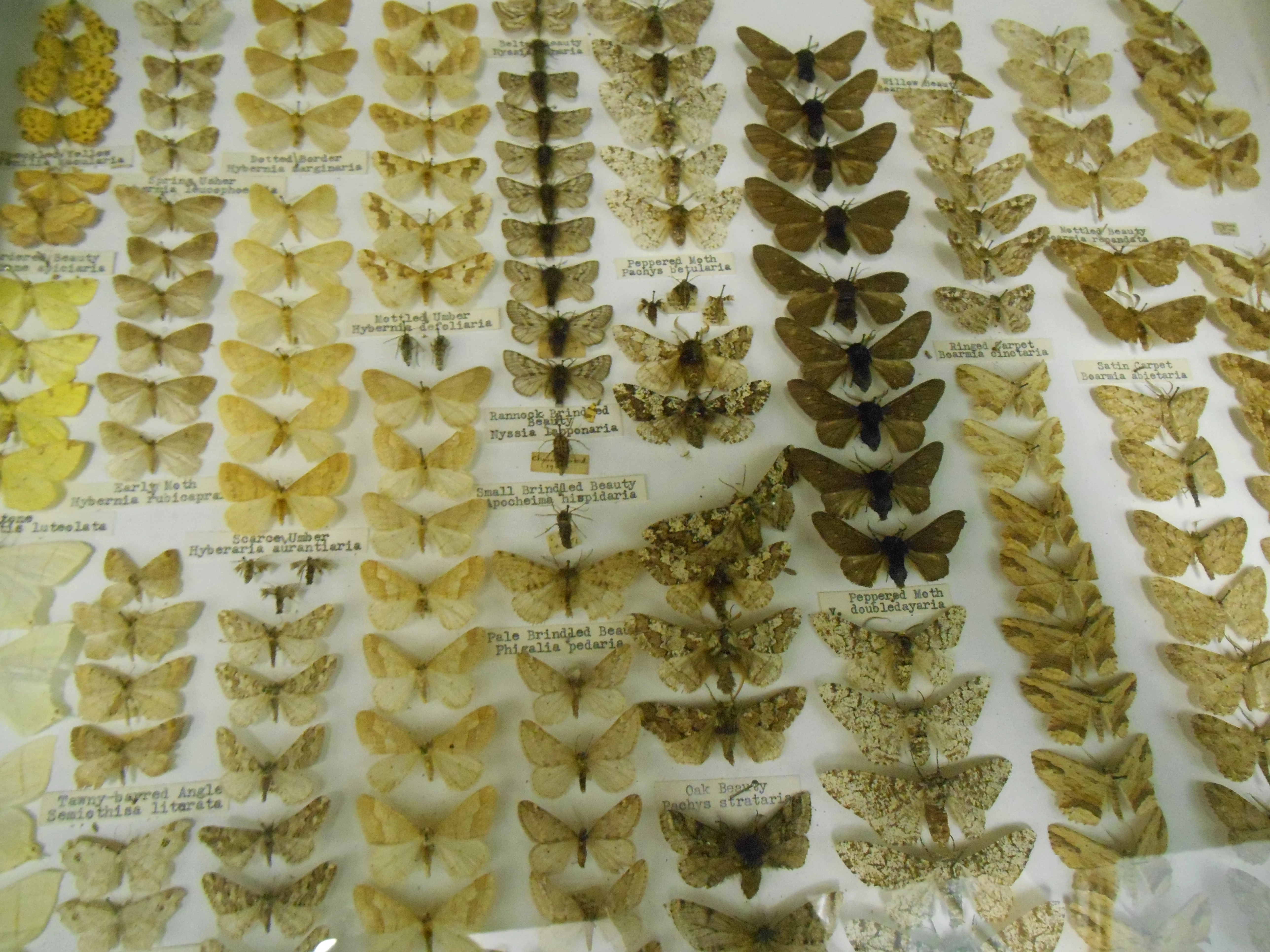
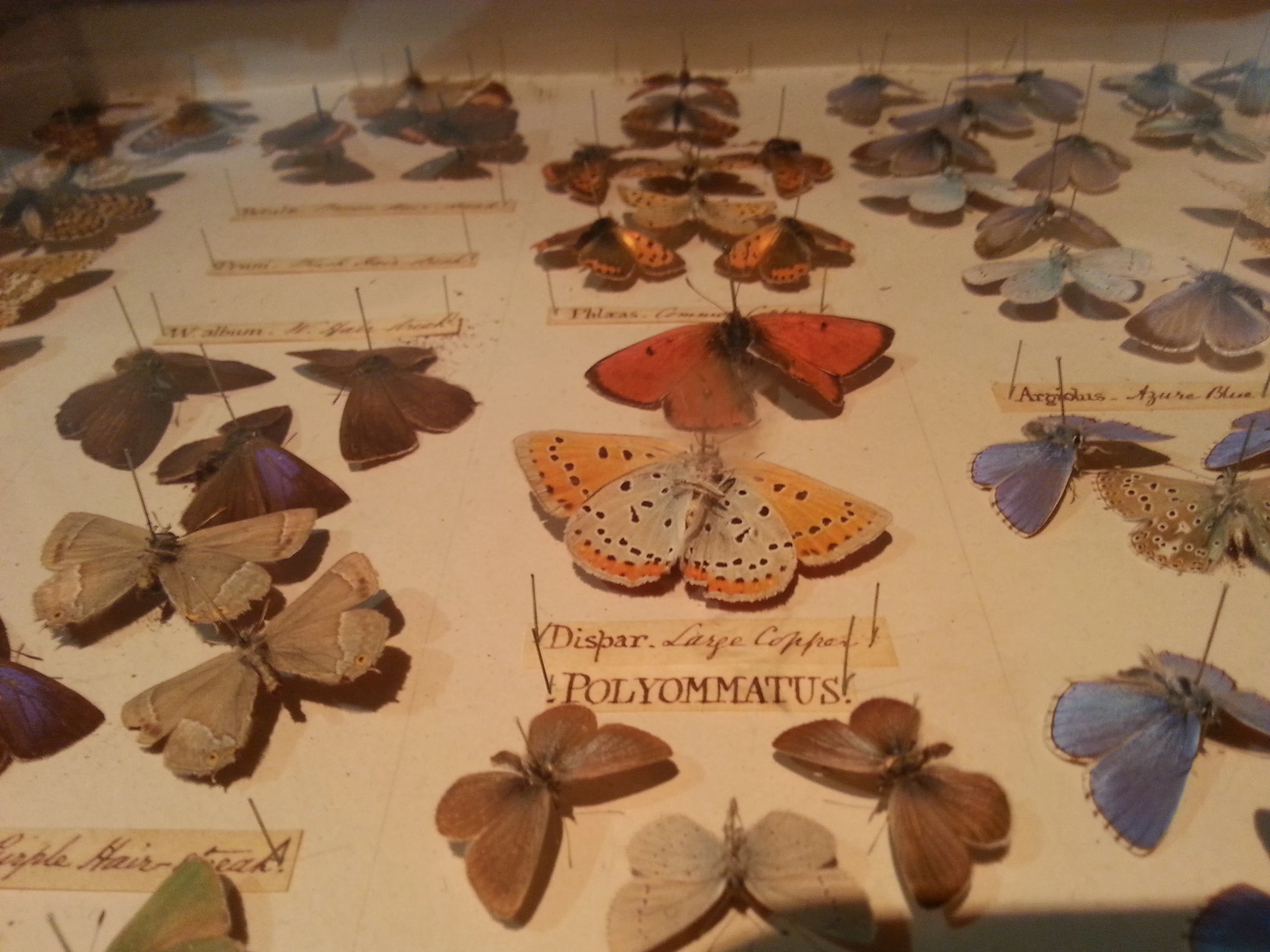
For the last two years we have put together an advent calendar celebrating some of the beautiful specimens in our natural history collections at National Museum Cardiff. We have been tweeting these from the @CardiffCurator Twitter account each day and will continue throughout December. The specimens behind the first twelve doors have been inspired by the song ‘Twelve Days of Christmas’.
We have compiled a Storify story on our advent calendar, which can be viewed here.
Two weeks ago, Botany Curators at Amgueddfa Cymru-National Museum Cardiff welcomed scientists from across Europe, including Romania, Bulgaria, Germany and Spain. The visitors, who are all experts in the study of plant fossils and pollen analysis, spent two days discussing how best to study the changes that have occurred in plant diversity over the last 400 million years. These changes are important as they help scientists understand how vegetation has influenced climate and environmental change in the past. The meeting included 17 presentations discussing the vegetation from different geological time periods. The visitors also had the opportunity to go behind-the-scenes at National Museum Cardiff to see a selection of rare plant fossils from the David Davies Collection and pollen specimens from the Hyde Collection. This meeting was fully funded by an exclusive grant from the European Science Foundation. It is intended that the workshop will inspire a series of international collaborative projects that will maintain the Museum’s reputation as a centre of excellence in this field.
We produced a Storify Story based on Tweets made throughout the conference.
What is the best way to store insect collections? Recently an enquiry was posted on NHCOLL-L (electronic forum for the care and use of natural history collections) about the use of wood as a material for insect storage cabinets. The question was:
What kind of preservative should be used to treat some new storage cabinets made of eucalyptus wood, that would not harm the insect specimens stored inside them?
The post sparked a discussion about ideal insect storage. Below is a little summary of the factors to consider when planning storage for your entomology collection.
The ideal solution
The ideal solution for insect storage in most situations are metal cabinets, which are robust, relatively cheap, made with a high degree of consistency and can be made air tight (well, almost). This will protect the collection against insect infestations, airborne pollutants and humidity fluctuations (although not temperature fluctuations – cf. Szcepanowska et al. 2013.
Why use wood preservatives?
However, if you do need to use wood for the cabinets, you should consider the following concerns.
Usually, the reasons for treating wood with preservatives are either:
to make it more hard-wearing (in the case of wooden floors), or
to stop it being attacked by fungi or insects, or
to prevent it from greying when exposed to UV light.
Most of these issues are problems mainly in outdoor applications of wood, and there are a number of ways of dealing with these: wood can be varnished to make it protect it from physical impacts, stained to protect it from UV light, and pressure-treated or painted with insecticides and fungicides (ranging from highly toxic substances, such as pentachlorophenol, to less hazardous ones, such as borax).
Assuming the entomology store is dry, has a low relative humidity, clean and there is no problem with insect pests – which should all be the case to safeguard the collection, never mind the storage cabinets – there is really no reason why the cabinets need a finish at all. This applies to all woods – whether in a museum or in a domestic situation, wood used indoors should not require any treatment to protect it from fungal or insect infestations, or greying. Coming back to eucalyptus wood in particular: this has a naturally high content of polyphenols, which makes it naturally resistant to mould growth and insect attack, further negating the need to treat it.
There is one exception: if old cabinets are bought from another institution there is a danger that pest insects may be present already, which could introduce them into the new location. It is advisable therefore to check any old cabinets thoroughly before they are installed – better still, before they are transported to the new location. This then gives time to investigate appropriate treatment options, which are not restricted to chemical means; instead, the units may be frozen, heat-treated or treated in a nitrogen chamber. But that is an entirely different subject which shall be discussed in detail elsewhere.
Organic acid emissions
A further question was the issue of emissions of volatile organic compounds (VOCs). Wood naturally emits many different VOCs, including acetic and formic acids, which is a problem in many museum collections (e.g. causing Byne’s disease in Mollusca and egg collections, and enhancing pyrite decay in geological collections). There does not appear to be a problem with VOCs affecting insect specimens themselves, although organic acids frequently lead to pin corrosion in insect collections. Many wood preservatives may exacerbate the problem of VOC emissions from storage cabinets. As we always look for ways of lowering such airborne pollutants in museum stores and galleries there is another reason against the use of wood preservatives in entomology stores – actually, ANY museum stores.
What material to choose for the drawers? Experience has shown that plastic drawers have problems with static electricity charging, which attracts dust. Metal drawers can be heavy and unwieldy. Wooden drawers still appear to be very much the most practical way of storing insects. However, the type of wood used should not emit large amounts of VOCs, and the drawers should have well-fitting lids to keep out pests. If you wanted to use a locally sourced (sustainable and ethical) wood you might have to undertake a little research. Generally, hard woods are better than softwoods (drawers made from softwood can warp with time and often contain large amounts of resin), although many imported tropical woods used in days gone by are now controversial for environmental and social reasons. When researching the potential suitability of different wood types, try tracking down a comparative study of the VOC emissions of different local hardwoods, which would give you an indication of those high emission species to avoid in the construction of drawers.
Further guidance
The UK’s Natural Sciences Collections Association [http://www.natsca.org/] has published some guidance on the construction of insect storage units:
NHCOLL-L is a general purpose electronic forum for those with an interest in the care, management, computerization, conservation and use of natural history collections. Hosted by Yale University, NHCOLL-L is co-sponsored by the Society of the Preservation of Natural History Collections (SPNHC) and the Association for Systematic Collections (ASC, Natural History Collections Alliance).
Disclaimer: The links in this article are purely examples of potential pest management but by no means an endorsement of particular companies or organisations.
Every Monday curatorial staff from the Department of Natural Sciences at Amgueddfa Cymru - National Museum Wales highlight some of the fantastic mollusc specimens from our collections, on Twitter using the hashtag #MolluscMonday
The Molluscan collections at Amgueddfa Cymru — National Museum Wales number some 180,000 lots from many different collections which have been amalgamated into one systematic sequence.
The most historically important part of the collections is the Melvill-Tomlin collection which came to us in 1955 and contains over 1,000,000 specimens!
Want to find out more? Why not follow us on Twitter @CardiffCurator or @NatHistConserve or follow the hashtag #MolluscMonday to find out about this fascinating group of animals. Lots of people have been joining in so why not join in the fun!
Look out for some of our favourite hashtags, for ex. #MolluscMonday, #BotanicMonday, #WormWedneday and #FossilFriday.
In June this year the Natural Sciences Department received a rather special donation from the Royal Botanic Gardens, Kew; a life size model of a giant millipede, Arthropleura, that would have lived in the Carboniferous Period, 300 million years ago. Arthropleura is the largest invertebrate (creepy-crawly) ever known to have lived on land, reaching up to 2.6 metres in length, but despite its monstrous proportions it is thought to have been a harmless herbivore.
The model was originally on display in Kew Garden’s Evolution House but when the space was dismantled in preparation for the HLF funded restoration of the Temperate House, it was no longer needed. So it was donated to Amgueddfa Cymru – National Museum Wales, thanks to the generosity of Chris Mills, David Cook and Jonathan Farley at Kew.
The Arthropleura model was in need of some substantial conservation work when it arrived at AC-NMC. It had been on open display for many years in a glass house alongside living plants and was damaged and rusty. The humid display environment had caused the surface paint to flake away and several spiders and snails had taken up residence on the underside of the model!
The first job was to give the model a good wash with hot soapy water and remove the dirt and cobwebs! Then all the flaking paint was scrubbed off, the damaged areas on the legs and head were rebuilt with an epoxy putty and the surface textures recreated. The nuts and bolts of the removable antennae had rusted together, so the metal parts were replaced with new stainless steel threaded rods.
Once the repairs were complete the model was carefully painted with acrylics and then coated in a durable varnish, making it once again suitable for public display.
Some of the Natural Science staff had become rather attached to the impressive 1.5m long millipede model whilst it underwent conservation work in the lab and named it Arthur the Arthropleura! We also decided to have a bit of Halloween fun with Arthur… so he “escaped” and went on the run around the museum galleries! We posted pictures of his adventures on the @CardiffCurator Natural Sciences Twitter account and had a fantastic response from our followers. Arthur the Arthropleura is now a social media star and is a really wonderful addition to our collections!