Cardiff Creative Writers

Objects are evidence of somewhere, something, or somebody and as such all have stories to tell.

Recently a class of adults studying creative writing at Carduff University attended a workshop here with me in the Clore Discovery Centre. They took on the role of a curator and wrote their own creative labels for some of their favourite objects in the gallery. Here are a few examples:


Iron-Nickel Meteorite (Approximately 4.5 billion years old)

 I wandered lonely, in a cloud of fragments, beyond the Martian orbit, since the beginnings of the Solar System some four-and-a-half billions of years ago. A passing satellite, en-route from Earth to who knows where, disturbed my orbit, and I fell towards the distant sun. Later, I felt the pull of Earth, and spiralled down into its gravity well – faster and faster until in fiery glory I blazed across the sky, a meteorite. Though reduced in size, I fell to earth. A fragment of the ancient history of the Solar System – a messenger from outer space – here I lie in The National Museum Collection.

David Edwards


What is it? Popular wrong answers include a drinking vessel or a paperweight!!

 It is an axe head. Bronze Age man hafted it to a wooden handle and used the D shaped loop on the side for strapping.  Butchering, wood-cutting and self-defence are among possible uses for this versatile tool.

 Mike Dolan


A snakestone fossil

thought to be magic,

I was a cephalopod

with head and foot fused.


In life I relied

on plain hydraulics

a siphuncle curled

like a twirling straw


adjusted the pressure

in my chambered coils,

let me rise and fall

as I dodged ichthyosaurs.


Anne Bryan


Arctic Ocean exploration 11th May

Friday
Since the last blog we have moved to shallower water which means that it takes a much shorter time to take the samples, less time between stations and a more hectic schedule. With the 12 hour shifts I have had little inclination to sit at the computer. Perhaps most spectacular have been the samples from the sponge grounds, some of these are the size of footballs. They are difficult to work with without gloves because of the spicules and worsened by the rather nauseous smell given off by some. Sorting and fixing such a large sample had everyone running around madly.


The Campod live video gear has been working, it is lowered to the sea bed and then hopped along a transect some 700metres long. The footage is stored and the megafauna analysed to create a chart of animal communities. You can see some of this video on the Mareano website http://www.mareano.no/english/. You can also read all about the programme in detail. We did a similar thing for the seas around Wales and published the results in our Biomor Reports but we did not have the video or geophysical data to go with our benthic sampling, wouldn’t it be interesting to have seabed images for all the communities we have found in the Irish Sea?


As far as my research goes we have collected a lot of relevant material. Firstly I have seen common Norwegian Sea species that just enter the British fauna and some that are found in both regions or so we think! I now have material of thyasirid bivalves to compare with those we have from the Atlantic Frontier Environmental Network  (Shetland-Faeroes) programme and can hopefully describe some new species now.


There is one family of bivalves that are always problematic, the Astartidae, and I now have a good series of northern A. sulcata fixed in 100% ethanol and RNA later for a molecular study that might be joint with the Bergen Museum.


I have not got Anna any Macoma for her tellinid study but I do have quite a few Abra longicallus a species we only get on the Porcupine Bank west of Ireland.


Andy has been building up an impressive collection of photographs of living polychaetes, he will post some of these on our “return to home” final blog.


We dock early tomorrow morning in Bodo so it is now a frantic pack, tidy and clean period so I had better go.

Pengwiniaid yr Antarctig

Pengwin

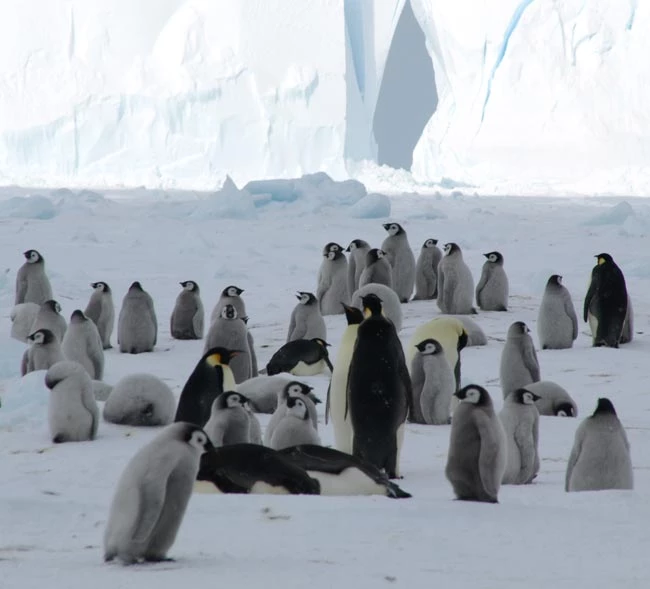
Mae'r pengwin yn anifail sy'n archdeip o'r Antarctig ond dim ond dwy rywogaeth, y Pengwin Ymerodrol a'r Adélie sydd i'w canfod yn yr Antarctig yn unig. Mae'r pengwiniaid Antarctig eraill, fel y Chinstrap a'r Gentoo, hefyd i'w gweld ar yr ynysoedd is-Antarctig. Mae rhywogaethau eraill hefyd sy'n byw mewn hinsoddau cynhesach — yn wir mae Pengwin y Galapagos yn byw ar y cyhydedd bron. Fodd bynnag, maen nhw wastad yn byw lle mae dŵr oer iawn yn llifo o'r de. Adar diasgell ydyn nhw sydd wedi esblygu i fyw yn y môr, lle byddan nhw'n treulio'r rhan fwyaf o'u hamser.

Y Pengwin Ymerodrol yw'r mwyaf gan gyrraedd taldra o dros fetr a phwysau o 22-45 kg. Capten Scott oedd y cyntaf i gofnodi arferion mudo'r Pengwin Ymerodrol, ar Alldaith Discovery 1901-04. Maent yn dod i'r lan ym mis Ebrill ac yn cerdded cymaint â 100-160 km i'r meysydd bridio. Wedi dodwy un ŵy, bydd y benyw yn dychwelyd i'r môr i fwydo, gan adael y gwryw i ori drwy aeaf garw'r Antarctig. Bydd yn dioddef naw wythnos o dymereddau yn agos i -50°C a gwyntoedd o hyd at 200 kya. All y gwryw ddim bwydo drwy gydol y cyfnod ac erbyn i'r benyw ddychwelyd yn gwanwyn bydd wedi colli 45% o'i holl bwysau!

Casglai'r fforwyr cynnar i'r Antarctig bengwiniaid er mwyn eu bwyta, ond byddai rhai yn cael eu casglu fel arbrofion gwyddonol. Mae nifer yn y casgliadau yma yn Amgueddfa Cymru.

Peter Howlett a Tom Sharpe

Ocean exploration north of the Arctic Circle

Dr Graham Oliver and Dr Andy Mackie from the Department of Biodiversity and Systematic Biology have been offered the chance to take part in a research cruise to the Arctic waters of northern Norway. This cruise is part of the Mareano project, which aims to map the bathymetry, sedimentology and biology of the seabed around Norway. Graham and Andy will be looking for deep water bivalves and ploychaete worms to augment their research here.


Graham takes up the story:

Our ship is in port and we are now on board waiting to depart for the research area south of the Lofoten Islands. Once there we will be taking samples from depths between 200 and 2500metres.

We have arrived in late spring but already the days are long with the sun coming up well before 5am, but then we are north of the Arctic Circle. The snow is still lying thickly but the bright weather makes the mountainous backdrop really spectacular.

We sail around midnight and it will take 24 hours to reach our first station when we start our 12-hour shifts. Lets hope we can then show you the ship at work and hopefully some of the marine life in the Norwegian Sea.

In the meantime here is a flavour of Tromsø. The town is a mixture of old and new, all jumbled up and reflecting a boom time in the 1960’s. The wooden houses are typical of the old town and the Polar museum represents a most modern addition. The city is surrounded by rugged scenery of fjords and mountains. Our ship the GOSars is named after an eminent marine biologist and one of the most modern in the Norwegian research fleet.

Arctic ocean exploration: Monday 29 April

We spent the last 24 hours doing little while a Force 9 gale stoped all sampling, waves were washing over the trawl deck. At last the beam trawl is out now and sampling at just under 2000m. We have completed one station at 660m.

At every station we take samples with a Van Veen grab, a box core, a beam trawl and an epibenthic sledge. The grab and box core are launched from the hangar which is in the middle of the ship, and the doors open close to the sea level. The sledge and trawl are launched off the trawl deck at the stern of the ship. The pictures show the hangar with doors closed and a remote video camera array in the corner. With the doors open the Van Veen grab is launched by the crew, not the scientists, we have no intention of falling into the Arctic waters.

The first beam trawl from 660m is now up and our first sight of life in the Norwegian Sea is on deck. This sample has many kinds of starfish and brittlestars of stunning colours along with an angler fish.