Casgliadau ac Ymchwil

Tom Sharpe's Antarctic Diary 2012-01-03

John Rowlands, 3 Ionawr 2012

Tuesday 22 November 2011

Overnight we sailed across McMurdo Sound and pushed into the fast ice along the coast of the mainland. It was a beautiful day today, except where we wanted to be - in the mountains.

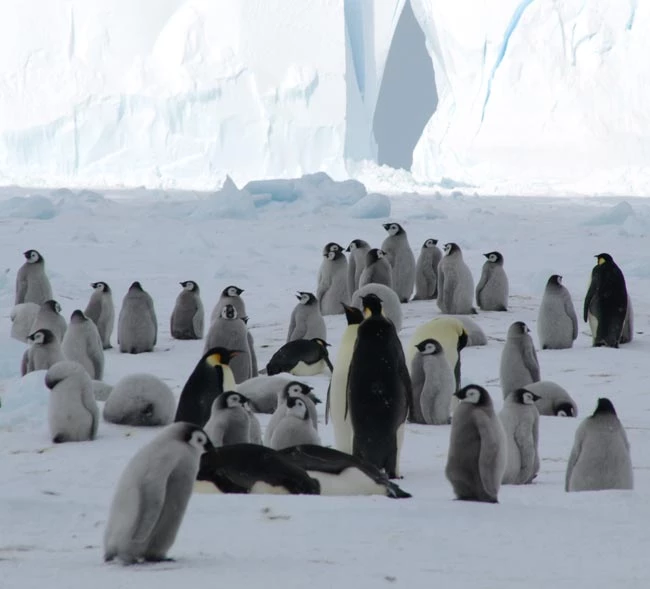
There, low cloud meant the helicopters couldn’t fly. So instead we spent the morning walking on the ice around the ship. Our presence attracted the attention of a group of Emperor penguins who were just as interested in us as we were in them. They were definitely there to have their pictures taken! They leapt in and out of the water, waddled back and forth, stood, posed and almost smiled for our cameras.

By early afternoon the weather showed signs of improvement, so we flew across the fast ice and into the Taylor Valley, one of the Dry Valleys. These are remarkable features, the largest ice-free area in the continent. Taylor Valley was discovered by Scott on his first expedition while returning from a sledging trip to explore the Polar Plateau with Edgar Evans from Rhossili on Gower.

The Dry Valleys are a polar desert where the rocks are smoothed and sculpted by sand blown by katabatic winds which hurtle down from the Antarctic ice sheet at speeds of up to 200 mph. They attract a lot of scientific attention, especially from NASA, as this is probably the closest we have to a Martian landscape and climate. It was a real thrill to experience this incredible landscape.

The valley is strewn with moraines with huge variety of rock types. Two geologists from Scott’s last expedition, Frank Debenham and Griffith Taylor, explored this valley and collected from these moraines. This gave them samples of rocks from deeper into the Transantarctic Mountains which they did not have time to explore.

Wednesday 23 November 2011

After a bright sunny night, we awoke to find ourselves back in the fast ice of Ross Island, this time offshore of Cape Evans. Visiting Shackleton’s Hut was wonderful, the Dry Valleys exceptional, but today was very much the icing on the Ross Sea cake, and for most of us, the whole reason for this trip - a visit to Captain Scott’s hut, the hut from which he left for the South Pole and to which he never returned.

Almost buried in snowdrifts, the hut has a powerful presence, seeped as it is in Antarctic history. Stepping through the door was a strange experience. In front of me was a large room that I knew well, but I was seeing it for the first time in colour. I know this hut from the famous photographs of Scott’s expedition photographer, Herbert Ponting.

I was standing where he stood, at the end of the long table, when he took the picture of Scott’s birthday. I stood between the sleeping bags of Teddy Evans and Edward Wilson, from where Ponting photographed Scott sitting at his desk. I saw the empty Tenements, the bunks of Apsley Cherry-Garrard, Birdie Bowers, and Captain Oates, and could visualise them there, as in Ponting’s photograph. Above Oates’ bunk - his pinups: pictures of horses and dogs. Atkinson’s laboratory, his test tubes and equipment still on the bench; the Geologists’ Cubicle, with rocks on the floor beneath Frank Debenham’s bunk; Ponting’s darkroom, still smelling of developer and fixer; the Stables where Oates cared for the ponies, and the stove he used to heat their chaff; Clissold the cook’s galley with its stove, utensils, and canned foodstuffs; and, dividing the hut, a wall of crates of Coleman’s mustard, Fry’s chocolate and other supplies. All of these are still where Ponting photographed them a century ago.

Of course, a feeling of sadness and tragedy pervades this hut; it is almost tangible. Almost exactly 100 years ago, Scott, Oates, Bowers, Wilson and Edgar Evans left this building and set out for the South Pole and a frozen death.

Less well known is that this hut was used by Shackleton’s Ross Sea Party who were laying the depots for his doomed crossing of the continent in 1916. Three of their number lost their lives on the ice near here. A forlorn, poignant pencilled scribble beside a bunk records “Loses to date Hayward, Mack, Smith”. In their memory, their colleagues erected a wooden cross on Wind Vane Hill near the hut.

The setting of the hut was enhanced by some suitable weather today; kind enough at times to allow our helicopters in, but showing how quickly the weather can change here. Snow showers, fine spindrift, a driving wind and windchill of -10oC reminded us what conditions here can be like, even less than a month from midsummer.

Tom Sharpe's Antarctic Diary 2011-12-22

John Rowlands, 22 Rhagfyr 2011

Monday 21 November

We've continued to push south, although by a rather round about route to avoid the thickest pack ice, and passed 77o south latitude.

On the western horizon we had an incredible view of the Victoria Land coast of mainland Antarctica and the Transantarctic Mountains. To the south we could see Ross Island and Mount Erebus, the most southerly active volcano on earth.

We eventually broke through into a large area of open water as we entered McMurdo Sound. As we sailed along the west coast of Ross Island, we headed for a small bay at Cape Royds and ran the ship up onto the fast ice - thick sea ice attached to the land. From there it was a short helicopter ride ashore.

A walk of a few hundred metres took us to a sheltered little cove where, protected from the winds by a ridge of glacial moraine, there stood a small wooden building. This was the base hut of Ernest Shackleton's Nimrod Expedition of 1907-1909. A major conservation project by the New Zealand Antarctic Heritage Trust has recently completed work on the hut and its contents, and they've done a magnificent job. Tins of food are still stacked on the shelves, sledges rest on the rafters, clothing and sleeping bags lie on the beds, and crates of supplies are piled against the outside wall. To stand in this hut is awe inspiring.

On this expedition, Shackleton pioneered a route which Scott would later follow through the Transantarctic Mountains, and got within 97 nautical miles of the South Pole. Although he knew he could be the first to reach the South Pole, he turned back. He realised that if they continued they would not have enough food to make it back alive.

Shackleton took several scientists with him, one of whom was a St Fagan's born geologist, T.W. Edgeworth David, then Professor of Geology in Sydney. Based at this hut, David led the first ascent of Mount Erebus, 3795 metres high, and also led another team on a long sledging journey up onto the Polar Plateau to reach the South Magnetic Pole.

We had time to see the hut and take a walk to the most southerly penguin colony in the world, on the coast around Shackleton's hut. The Adelie penguins here provided an extra source of food for the expedition.

Instead of flying back to the ship, I opted to hike back across the fast ice to retrieve some marker flags we had laid out as a walking route in case the weather turned. This is perfectly safe as long as you keep a look out for tide cracks - fissures in the ice caused by tidal movement.

Their dangers were demonstrated when my hiking companion immediately fell into one. Luckily he went down only a couple of feet. It was just as well, as he had the rescue line.

Mapio Hendre'r Ywydd

Sara Huws, 22 Rhagfyr 2011

Gair bach clou i sôn am y map dwi wedi ei greu, i geisio mapio tirlun Llangynhafal a thu hwnt, yn y 1500au.

Fe welwch arno adeiladau sy'n debygol o fod wedi bod yn sefyll yn y cyfnod hwnnw. Anghyflawn yw'r map ond mi fydd yn esblygu, gobeithio. I'w greu, dwi wedi cyfuno data cyhoeddus Coflein, Ordnance Survey, Archif Sain Ffagan, google a Phrosiect Dendrocronoleg Gogledd Cymru*.

Dwi'n gobeithio ychwanegu mwy o wybodaeth am ddyddiadau'r adeiladau, lluniau ohonynt ac ati, fel mae'r gwaith yn mynd yn ei flaen. Gallwch ddefnyddio'r zoom i deithio ymhellach o filltir sgwar y tŷ:


View Llangynhafal 1510 in a larger map

* Dendrocronoleg=term ffansi am ddyddio boncyff.

Chwilio am Gartref Hendre'r Ywydd

Sara Huws, 20 Rhagfyr 2011

Dwi’n teimlo’n gartrefol, braidd, yn Hendre’r Ywydd Uchaf erbyn hyn. Mae na hogle tân coed yn y swyddfeydd a mae’n gwneud i mi deimlo’n anidding, yn edrych ymlaen at y Gwanwyn, pan gâi dreulio mwy o amser yno. Efallai eich bod wedi ymweld â Sain Ffagan droeon, ond heb dreulio llawer o amser yn yr adeilad dan sylw. Mae’n aelwyd weddol wag, yn bennaf am fod dodrefn o’r cyfnod addas yn rhy fregus i’w harddangos yn yr awyr agored. Fe ddowch o hyd i’r rheiny yn yr oriel. Yn ogystal â hyn, does dim simne ar y tŷ, sy’n ei wneud yn le anodd i weithio ynddo, ac i ymweld ag e, hyd yn oed, os nad yw’r tân yn bihafio.

Adeilad ffram-bren yw Hendre’r Ywydd, a symudwyd i'r amgueddfa yn y 1960au. Er i rywun fyw ynddo tan 1954, dwi’n gobeithio dysgu mwy am yr adeilad, a sut y defnyddiwyd ef, yn oes y Tuduriaid, gan ddefnyddio amrywiaeth o ffynonellau a sgiliau. Fe fues i’n cael modd i fyw yn coginio a dehongli yno dros yr haf and dwi’n edrych ymlaen at gael torchi llewys a phrofi sut le yw e i weithio ynddo o ddydd-i-ddydd.

Mi fydde ymroi i’r hen ffordd Duduraidd o fyw, ar yr adeg hon o’r flwyddyn o leia, yn beth annoeth i’w wneud, felly dwi am dreulio’r misoedd llwm yn archwilio cyd-destun a hanes yr adeilad.

A mae llwyth ohono. Mae ysgolheigion a haneswyr lleol wedi sgrifennu torreithiau o erthyglau am deuluoedd, adeiladau, diwydiannau a digwyddiadau Sir Ddinbych yn y cyfnod Modern Cynnar. Mae pentwr o erthyglau yn gwegian ar fy nesg, yn aros imi eu marcio â stribedi pinc a melyn. Ond rhaid dechre yn rywle. Fe benderfynais i ddod o hyd i safle gwreiddiol yr adeilad yn gyntaf oll.

Adeiladwyd Hendre’r Ywydd ym mhlwyf Llangynhafal, ger Rhuthun. Dwi’n weddol gyfarwydd â’r ardal, ond dwi erioed di gallu dweud yn sicr o ble daeth y tŷ. Dwi’n cofio gwrychoedd uchel a ffyrdd cul Dyffryn Clwyd, yn hytrach na’r hyn oedd ar yr ochr arall iddyn nhw. Yn lwcus, pan fydd yr amgueddfa’n symud adeilad, fe fyddwn ni’n creu archif am ei leoliad gwreiddiol, llawn mesuriadau, ffynonellau a mapiau. Fel arfer, maent yn gasgliadau arbennig:

Yn anffodus, yn achos Hendre’r Ywydd, gallwn weld bod mwy o ddiddordeb gan y curadur ar y pryd yn hanes a ffurf yr adeilad, yn hytrach na’r ardal a’r bobl fuodd yn byw ynddo. Roedd y ffeil yn llawn ffotograffau manwl o fframiau pren, cytiau lloi a drysau. Dim ond dau gliw oedd yno allai fy helpu’r tro hwn: copi o gopi o gopi o fap o 1830, a dargopi o fap heb allwedd arno. Nodwedd gyffredin rhwng y ddau fap oedd y stribed o dir oedd yn culhau tua un pen. Dyma ble, ym 1508, yr adeiladwyd Hendre’r Ywydd.

Yn reddfol, mi deipiais y manylion i mewn i google maps, i chwilio am stribed debyg yn ardal Llangynhafal. Roedd hynny’n gam gwag, fel y gwelwch chi:

Fe benderfynais i ailymweld â google ar ôl i mi wneud chydig mwy o waith ymchwil. Roedd yn demtasiwn i ddibynnu ar wybodaeth y wefan honno – ond mae’n tirwedd ni wedi newid cyn gymaint ers y 1500au, ac yn ogystal enwau ein tai, ffyrdd a thafarndai, ei bod yn ffynhonnell annibynadwy yn yr achos yma. Mi es yn ôl at y dargopi, a chanobwyntio ar y siapiau – lleoliadau nentydd a thraciau, a nodweddion anarferol yn y tirwedd.

Yng nghanol haniaeth hyn i gyd, daeth Coflein i’r adwy. Rwyf wedi bod yn defnyddio’r gronfa ddata i edrych ar hanes tai eraill o ardal Llangynhafal, yn y gobaith y gallaf greu pictiwr ehangach o gyd-destun bywyd y 1500au yn Nyffryn Clwyd. Mae’r gronfa ddata, sy’n cael ei rheoli gan y Comisiwn Brenhinol Henebion Cymru, yn cyflenwi cyfeirnod GPS ac Ordnance Survey ar gyfer pob heneb a hen adeilad sydd wedi’i gofrestru ganddynt. Gallwch weld cofnod coflein am Hendre’r Ywydd yma.

Mae casgliad o fapiau Ordnance Survey mawr yma yn llyfrgell Sain Ffagan, felly es ati i groesgyfeirio’r wybodaeth oedd yn fy meddiant. Mae manylder mapiau OS yn wefreiddiol, ac ar ôl chwilio'n fanwl (a chael help gan Guradur Adeiladau Hanesyddol Sain Ffagan) fe ddaethom ni o hyd i rywbeth oedd yn canu cloch. Croesffordd gam; nant gyfarwydd...

Wrth i ni edrych eto, sylwais bod rhywun wedi bod yno o'n blaen, ac yn groes i eticet archifol, wedi marcio'r map ag inc coch yn agos at leoliad y tŷ (mater o bwys dirfawr i nerd fatha fi). Ar ôl deffro o fy llewyg, dychwelais at awyrluniau google a chyn pen dim, roeddwn i wedi gosod pin yn y map. Gallwn weld yn glir bod y stribed o dir yn dal i fodoli, mwy neu lai, fel y gwelwn hi ar fap 1830. Mae'r heol gyfagos yn cordeddu fel honno ar y dargopi:

Roedd yn naturiol fy mod yn ysu i ymweld â'r lle. A diolch i google, dwi nawr yn gwybod bod safle'r tŷ yn gae o gorn melys. Er fod hynna'n swnio bach yn rhy debyg i un o ganeuon Arfon Wyn, dwi'n hapus iawn i ddechrau fy nhaith i oes Harri Tudur yn fan hyn:

Rho glic isod i ymweld dy hun:


View Llangynhafal 1510 in a larger map

Tom Sharpe's Antarctic Diary 2011-12-15

John Rowlands, 15 Rhagfyr 2011

Saturday 19 November

Today began grey, overcast and cold, with light snow falling on the ship. We’ve now been breaking our way through the pack ice of the Ross Sea for three days, picking our way south through whatever open leads or thin ice present themselves.

On the southern horizon, in places, open water shows up as dark reflections on the underside of the cloud - a ‘water sky’. In other places, we see ice blink, where the clouds are brightened by the presence of the sea ice beneath. Our navigation through the pack is aided by satellite positioning; Scott relied upon dead reckoning and the sun to chart his progress.

This afternoon we sighted land for the first time in five days. Away to the west we’ve had our first glimpse of the continent of Antarctica. The faint, white, distant mountains rise to over 3500 metres. Appropriately, one of the first we see, Mount Murchison, is named after a geologist who worked in Wales 180 years ago.

We set course for the mainland, a point called Cape Washington, but the pack ice is too thick, even for our icebreaker. Instead, we’re continuing south, deeper into the Ross Sea, in the hope of breaking out of the pack and into a polynya, which satellite pictures show lies to the south of us.

Sunday 20 November

It’s been slow getting through the pack ice, but we’ve finally made it to Franklin Island, at 76o south.

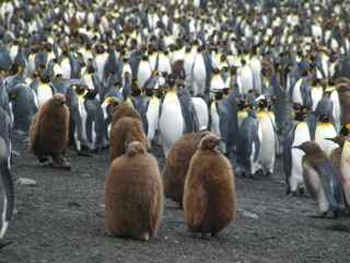
The ice is thick around the island, but we got within 5 miles of it, so we took the helicopters and landed on the sea ice at the foot of steep black cliffs. From there we hiked about a mile and half south across the ice to a large colony of Emperor penguins at the southeastern end of the island. These are the stars of the movies March of the Penguins and Happy Feet. They walk long distances across the ice to breed, and after the egg is laid it is transferred to the male who then stands on the ice through the severe Antarctic winter holding it on his feet.

The males in the colony huddle together against the cold. The march of the penguins was first observed by Captain Scott on his first expedition. Their chicks are some of the cutest things on the planet and infitinely photogenic. We have a couple of examples of Emperor penguins in our collections in Cardiff, including one presented to us by Lt Teddy Evans of Scott’s last expedition, and that will be in January.