The pitfalls and false trails of a taxonomist
, 2 Medi 2016
Collections work in Natural History is a process fraught with unseen difficulties. A project can, on rare occasions, proceed rapidly and uneventfully to a satisfying conclusion; however this is not the norm, and usually one soon finds oneself abroad in a treacherous jungle of scientific literature, beset on all sides by pitfalls and false trails, seemingly lost forever in a sea of confusion and miserable self-doubt. Such a process is a part of the standard working behaviour of the biologist, who is forever springing between the meteoric highs and dashing lows of their profession, drawn onwards in endless pursuit of the elusive Name with which to crown their specimen.
The naming game
Names in biology are contrary things, and the source of much agonising and confusion on the part of their employer. Upon discovery, each form of life is assigned a name, which, in theory, will remain with it forever, serving as its own unique cross-cultural reference code, and allowing it, again in theory, to be snugly positioned in the correct place in the proverbial tree of life. The system used, with a group-name (the genus) and an individual name (the specific), is much the same as that used to assign human beings into families – with great success – and would seem to be an ideal tool for defining the interlocking relationships of general non-human forms, but the small-scale elegance of the base idea melts completely away when applied to the vastnesses of known life, which currently musters some 1.2 million units (a number growing by the day). Beyond the inherent scaling problems which occur when expanding a small model by many orders of magnitude, further problems arise as our understanding of biodiversity evolves – relationships between members of a group, and between groups, are frequently revised, to an extent that rarely happens in the human example, as our nebulous understanding of deep prehistory is clarified, and our past mistakes are corrected.

Checking the checklists
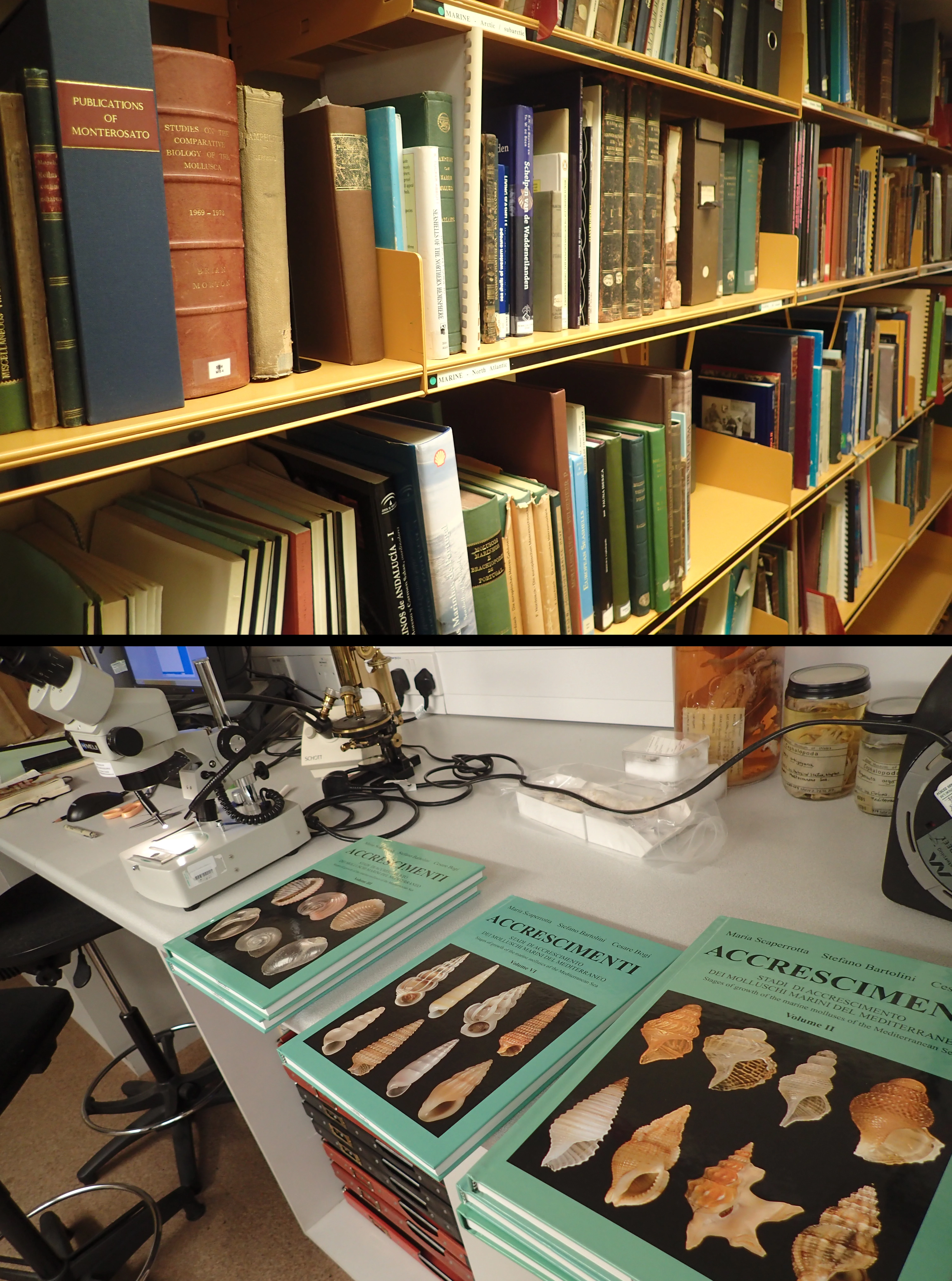
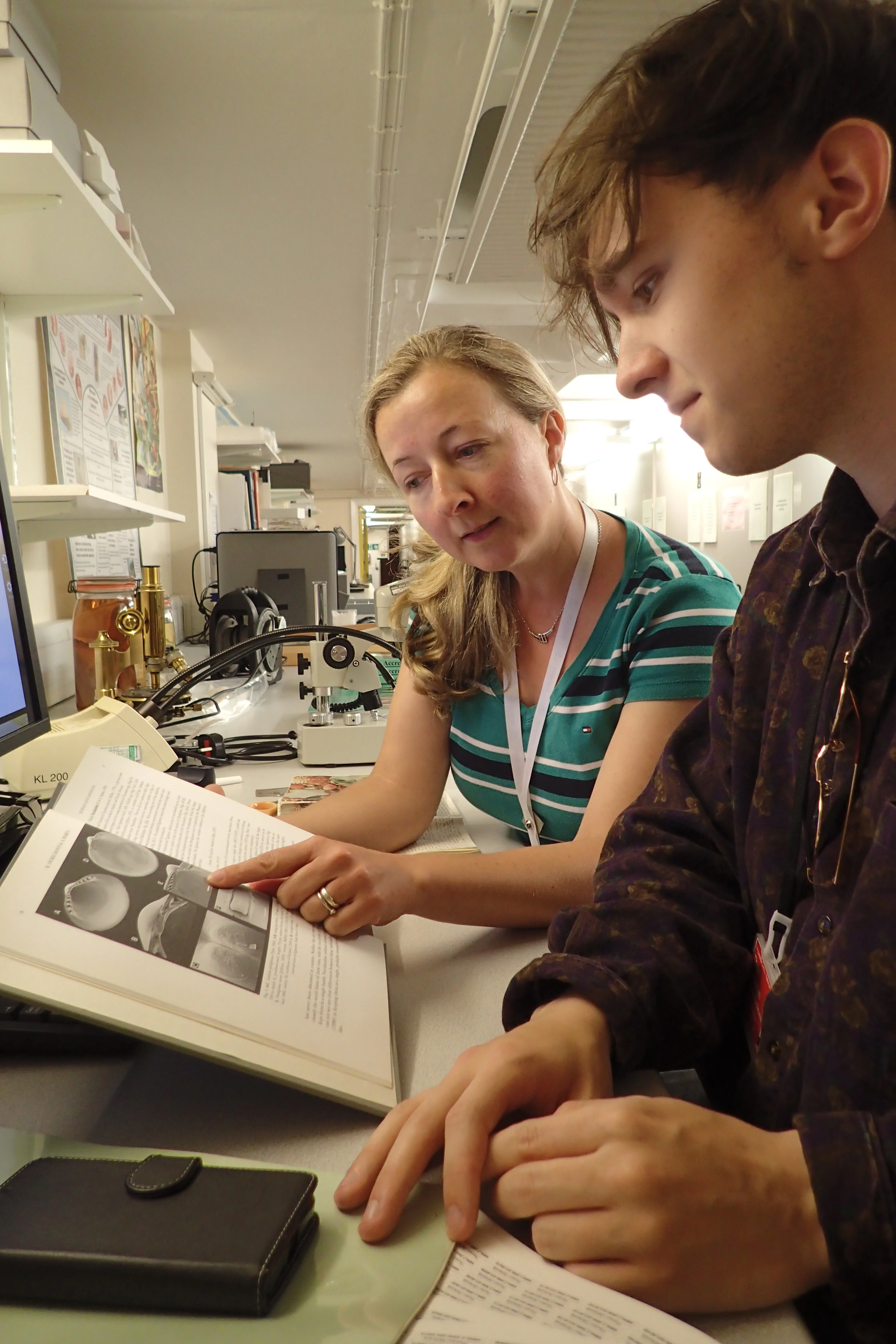
What does this mean for the average worker ‘in the field’, so to speak? If the material to be addressed is newly collected, not much – reference to current literature and up-to-date checklists should enable the specimen to be correctly identified and assigned the current iteration of its taxonomic name, as opposed to an older version which has been superseded (known as a synonym). However, as soon as your specimen is filed away the clock begins ticking down towards the next taxonomic revision of the group in hand, and when future researchers come upon it in the course of their studies then problems begin to appear. The material I have been working on, the Phorson collection of juvenile molluscs, ranges in age from twenty to forty years since the date of collection, and a lot of the nomenclature employed when the specimens were first identified has exceeded its shelf life by a considerable margin. In order to record the collection in the Museum’s databases to the greatest degree of accuracy, the correct name must be substituted, which is a simple process in the short term but greatly increases in difficulty as the specimens in question get older. Historic material from the early twentieth century or earlier is named and catalogued in archaic ways, often utterly incomprehensible to those trained in the most up-to-date traditions of taxonomy, and the evolution of the name into its modern form tends to become lost to history as the elapsed time increases, much as is the case with the evolutionary histories of real organisms. Older names tend to be referenced poorly and copies of the original texts where they were first proposed are difficult or impossible to come by, rarely accessible with ease and, when found, are impenetrable to the modern reader, extremely long, and often only available in foreign languages (in my last period of work at the Museum I spent many hours struggling with a book on planktonic molluscs, written in a combination of 19th-century Danish and Latin).
The digital age
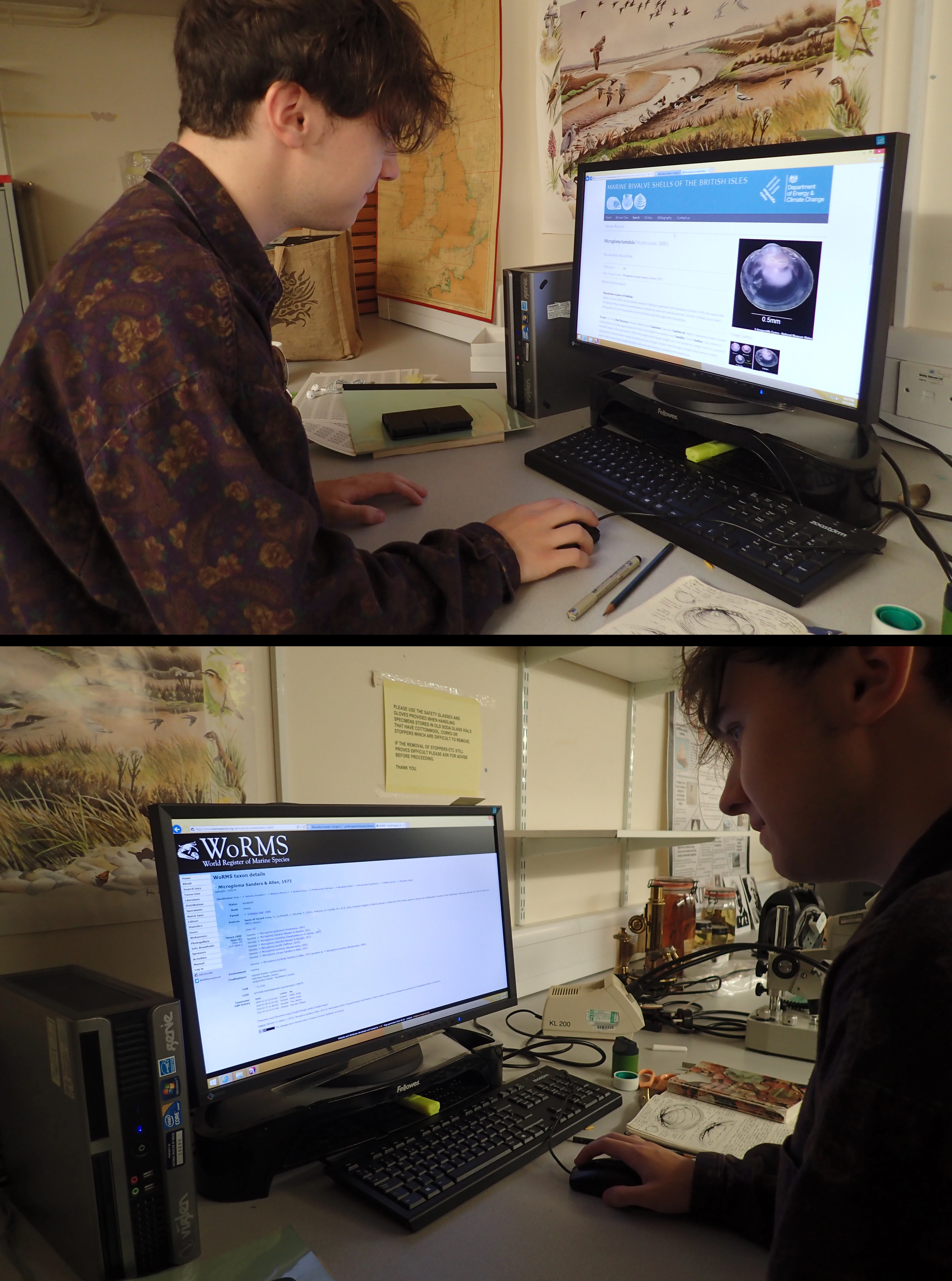
This may seem like a rather hopeless situation to find yourself in, even as an academic with access to a well-stocked library, but a solution is close at hand, one that opens historic records of taxonomic changes to everyone from the casually-interested member of the public to the paid researcher and the amateur specialist. Widespread online communications have allowed an organic model of constantly-updated databases to become the norm for the curation of large scientific datasets in the digital age, covering topics from biological records and species distribution (the National Biodiversity Network being the main system used in the UK) to the aforementioned taxonomic complexities that plague the curator. For alleviating this latter problem, the whimsically-named WoRMS (World Register of Marine Species) is one of the most comprehensive projects, and the one I have found myself using most often while working on the Phorson collection; administered by a large number of taxonomic editors, luminaries in their respective fields, the site serves as a searchable database for all taxonomic names of marine organisms, both those in current use and superseded synonyms, and enables the user to swiftly follow the links from the searched synonym to the version in current usage (where a full list of synonyms for the species in question is displayed).
Workers in the field of taxonomy have taken these ideas yet further, building new online projects to manage future changes in nomenclature in a way that simplifies things for everyone involved. Divorced from the limitations of the printed media, these sites can be updated as and when changes occur, making them an always-reliable source of up-to-date information on biological names, and a record of past changes as they happened. The National Museum of Wales’ ongoing project on the Bivalve molluscs of the United Kingdom (Marine Bivalve Shells of the British Isles: http://naturalhistory.museumwales.ac.uk/britishbivalves/) is a peerless example of this principle, addressing a field of study which has been historically poor in terms of identification guides and accessible publications aimed at those away from the ‘front line’ of research. The site is an online identification resource, where descriptions and photographs of the complete British Bivalve fauna can be viewed, compared and searched, and keys allow even those with no prior knowledge of the subject to work through the fauna until they find the correct match. This ‘opening’ of knowledge to those who were historically denied access – through their placement outside research institutions, or an inability to afford expensive niche publications, is part of a commendable shift taking place within the sciences, a quiet revolution championing the principles of free and open access to knowledge that would, in the past, have been hidden in a closed library or behind a paywall. The internet is a marvellous forum for the dispensation of the condensed expertise gleaned from the study of innumerable books and scientific papers, over decades and centuries. A colossal and terrifying volume of work to confront in its entirety, certainly, but when filtered into a useable format through the dedication of scientists and curators, a great doorway into the long galleries of human understanding of the world, thrown open to all who pass by and find themselves drawn in by stirrings of curiosity and wonder.
What the future holds…
During my work at the Museum I have had the rare privilege of watching the British Bivalves project grow, perhaps even through reference to the material from Ted Phorson’s collection that I have curated. These endeavours to open the galleries seem to me, in my more optimistic moments at least, to be a glimpse into the future of science and the curation of knowledge (which is perhaps the core function of the Museum as an institution) – a future where understanding is as familiar to us as running water, and the fruits of scientific endeavour can be beamed around the globe to anywhere an internet connection exists. Such prospects cause me quite unreasonable levels of excitement, at least until I realise that at online guide to the Gastropod (snail-shelled) molluscs is yet to be attempted, and they form the bulk of the British molluscan fauna; and I am brought heavily to earth again. It is a shame that I will perhaps not live to see the full extent of scientific digitisation, but I can console myself with the thought that, through my work at the National Museum of Wales, I may have left my mark somewhere at the very beginning. In any case I hope I have been able to express a little idealism without leaving myself open to accusations of naïveté and dangerous utopian thought; such is, after all, the prerogative of the millennial youth, of which I seem to have found myself a part, and after sifting the more arcane scientific literature for hours on end, a buoying thought and a cup of strong tea is a great necessity.