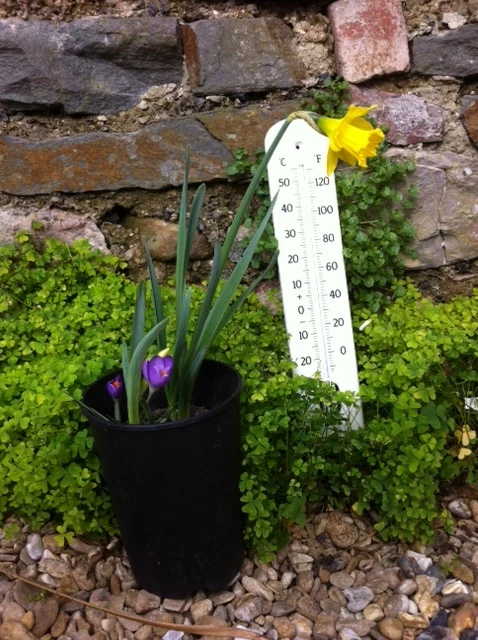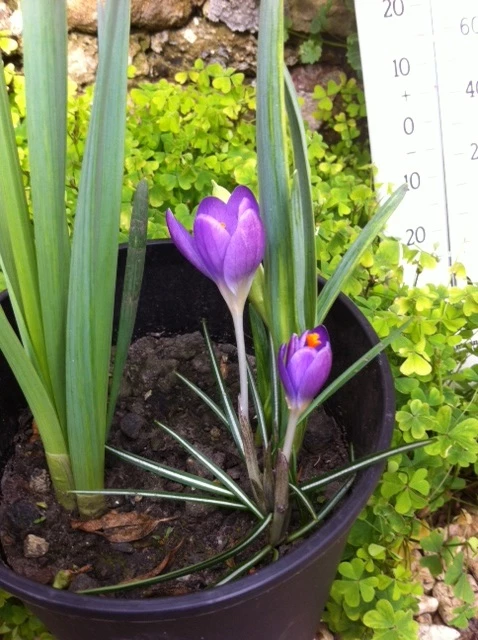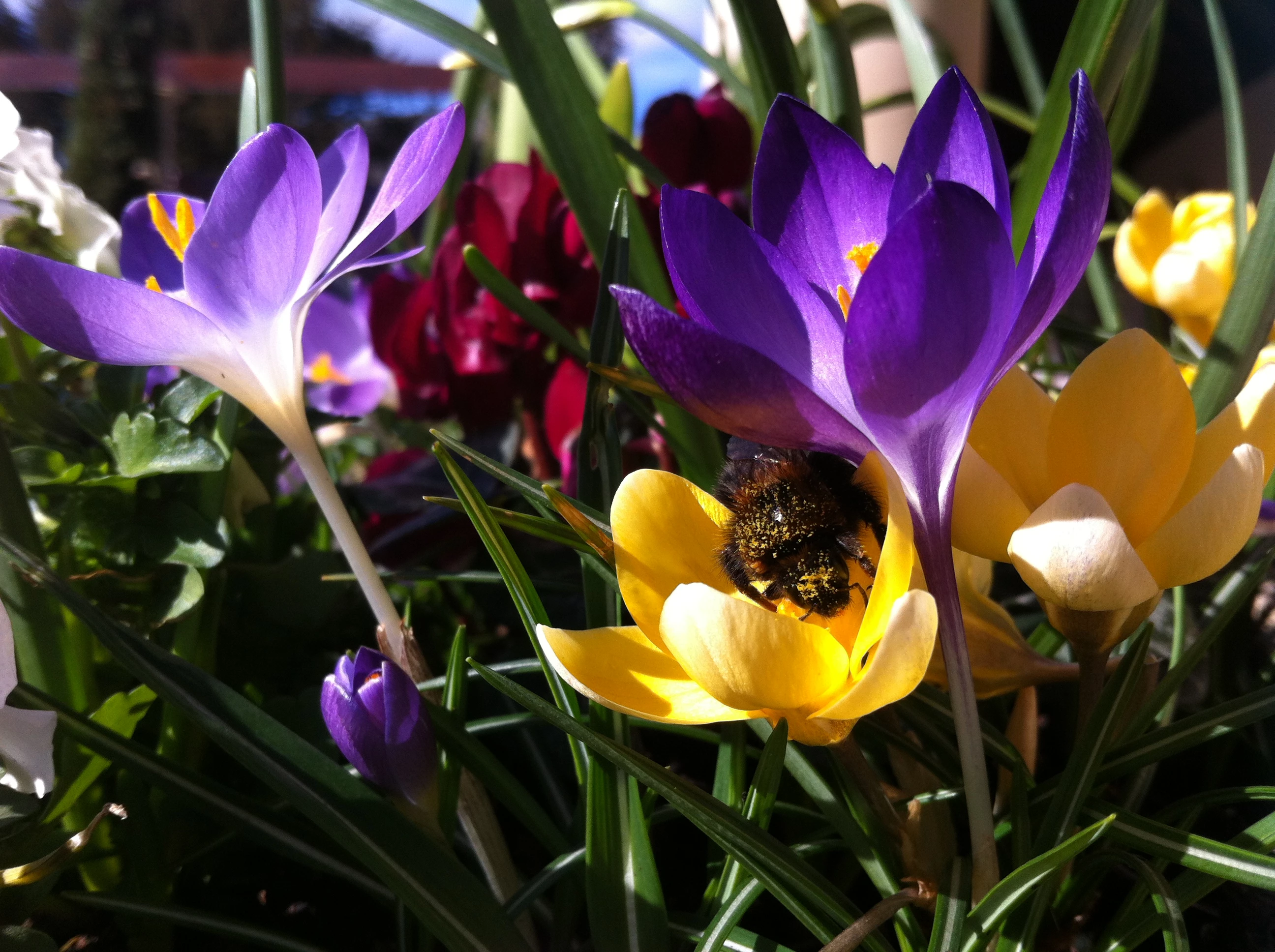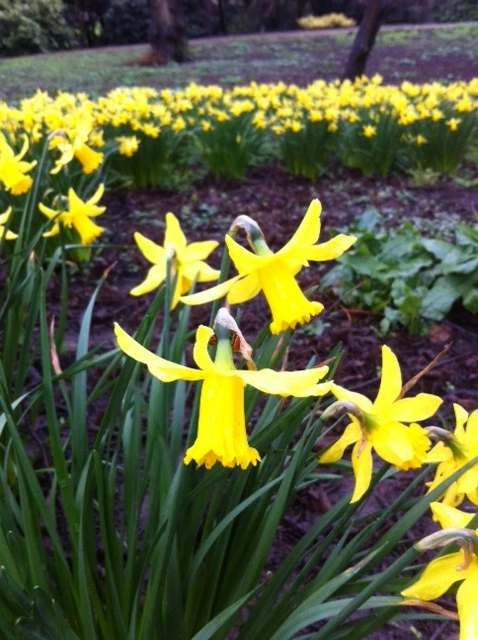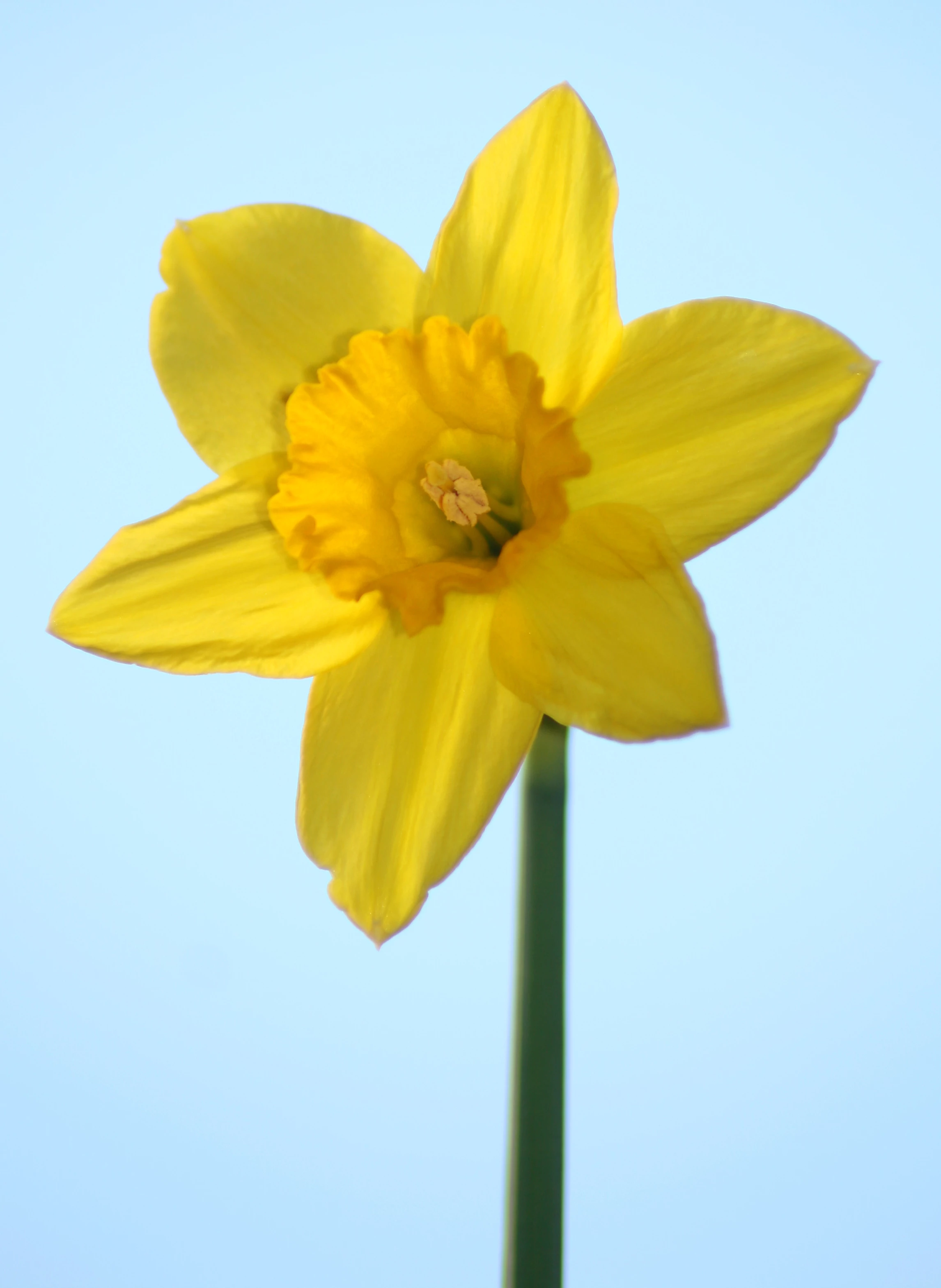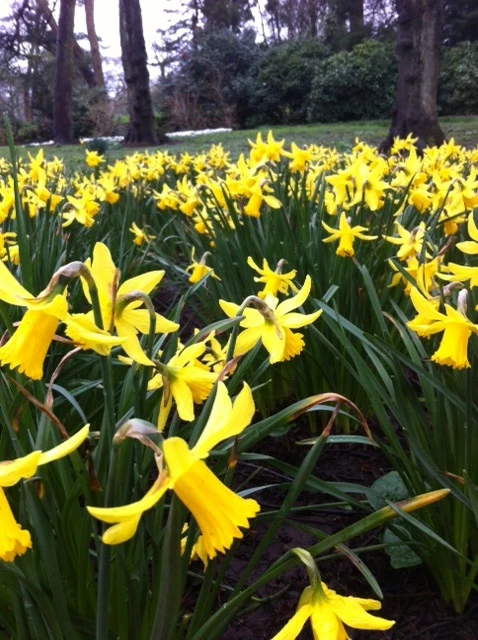
Gwanwyn yn Gwawrio Catalena Angele, 28 Chwefror 2014 Mae’r haul yn disgleirio drwy ffenest fy swyddfa yng Nghaerdydd ac mae’n teimlo fel gwanwyn o’r diwedd! Dyw fy mhlanhigion i ddim yn barod i flodeuo eto – mae’r cennin Pedr talaf yn 80mm o uchder a’r crocws talaf yn ddim ond 30mm o uchder – ond dwi’n siŵr y byddan nhw’n mwynhau’r heulwen! Fe dynnais i lun o’r cennin Pedr a’r crocysau yn eu blodau ym Mharc Bute yng Nghaerdydd y bore ’ma. On’d ydyn nhw’n brydferth?Pa ysgolion sydd wedi cofnodi eu blodau cyntaf?Cofnododd Ysgol Glan Cleddau bod eu crocws cyntaf wedi blodeuo, ac mae Ysgol Gynradd yr Archesgob Hutton yn Lloegr wedi cofnodi bod eu cennin Pedr cyntaf wedi blodeuo.Llongyfarchiadau, a da iawn chi am anfon eich cofnodion!Dyma Ysgol Gynradd Rougemont yn anfon y neges hon: Mae cyffro mawr yma yn Ysgol Rougemont Athro’r ardd ... mae ein BYLBIAU DIRGEL wedi dechrau blodeuo! Mae nhw’n edrych yn iach iawn gyda choesau byrrach na’r cennin Pedr a blannon ni. Rydyn ni’n meddwl taw Narcissus ydyn nhw, Tete a Tete efallai? Byddwn ni’n anfon ffotograff cyn hir. Athro’r Ardd: Mae hynna’n gyffrous iawn Ysgol Rougemont, a da iawn chi am ymchwilio i weld pa fath o Narcissus ydyn nhw – gwyddoniaeth gwych! Rwy’n edrych ymlaen i weld y ffotograffau.Dywedodd Ysgol Arbennig Kilmaron: ARSYLWI BYLBIAU’R LLYNEDD. Rydyn ni wedi bod yn monitro bylbiau crocws a chennin Pedr y llynedd i weld os yw’r hen fylbiau yn blodeuo cyn y rhai newydd. Ar ôl gwyliau hanner tymor dyma ni’n canfod bod bylbiau crocws y llynedd wedi blodeuo tra bod bylbiau eleni wedi blodeuo tua 7-10 diwrnod yn ddiweddarach. Rydyn ni’n gobeithio anfon cofnodion eleni tua diwedd yr wythnos nesaf. Athro’r Ardd:Arsylwi ac ymchwilio arbennig Ysgol Kilmaron! Rydych chi’n iawn bod bylbiau hŷn fel arfer yn blodeuo yn gynt na bylbiau newydd ifanc, ond y rheswm dros hyn yw eu bod nhw wedi cael blwyddyn ychwanegol i dyfu a storio bwyd. Ys gwn i ble fydd y blodau nesaf yn agor? Gallwch chi weld ble mae’r blodau wedi agor hyd yn hyn drwy edrych ar y map yma.Os nad yw eich blodau chi wedi agor eto, gwyliwch nhw’n ofalus. Gallan nhw agor unrhyw ddiwrnod!Cofiwch anfon eich cofnodion blodau ata i cyn gynted fydd y blodau’n agor. Os nad ydych chi’n cofio sut i wneud hyn, defnyddiwch y cyflwyniad PowerPoint Cadw cofnodion blodau, a darllen y dudalen Beth i'w gofnodi a phryd ar y wefan.CYNGOR CRAFF: Gall pob disgybl yn y dosbarth anfon eu cofnodion blodau. Mae’r holl ddata fyddwn ni’n ei dderbyn yn cael ei ddefnyddio i ganfod dyddiad blodeuo cyfartalog pob ysgol. Gwyliwch y siart crocysau a’r siart cennin Pedr i weld y tablau yn newid wrth i fwy o ddata gyrraedd. Mae’n bwysig ofnadwy bod pob disgybl yn anfon eu cofnodion, fel bod y wefan yn gallu cyfrifo dyddiad blodeuo cyfartalog yr ysgol. Bydd y cennin Pedr yn troi ei ben i lawr ychydig cyn blodeuo. Fydd y blodyn ddim wedyn yn llenwi â d?r ar ôl agor. Rhaid i chi gyd anfon eich cofnodion blodau er mwyn ennill y Gystadleuaeth Gwyddonwyr Gwych! Eich cwestiynau, fy atebion:Your questions, my answers:Ysgol Terrig: It snowed heavily on Monday morning and stopped about lunch time. Our bulbs are starting to grow :) Prof P: I’m glad your bulbs are growing, did you go out to play in the snow?Raglan VC Primary: We missed Tuesday because it was raining cat's and dog's, and we had bike training. Prof P: I love that saying! Can you imagine what it would be like if it really did rain cats and dogs? How would we measure that in our rain gauge?Chatelherault Primary School: Sorry we did not record information on Thursday because we were away all day at a school trip. We were excited to see little green shoots in some of the plants. Prof P: Thanks for letting me know Chatelherault, I hope you had fun on your school trip.Greyfriars RC Primary School: The plants are growing well and it's wonderful seeing them grow up. The mystery bulbs are really a mystery. from A and A :) Prof P: I hope your mystery will soon be solved Greyfriars!Arkholme CE Primary School: Unfortunately the plant pots are standing in water this week. Let's hope next week is drier. The mystery bulbs are growing better than the others. Flower buds just appearing. From H. Prof P: I am sure your plants will survive the rain Arkholme, keep watching those flower buds!Diolch yn fawrAthro'r Ardd
A Window into the Industry Collections Mark Etheridge, 27 Chwefror 2014 This month we have been donated six lamp checks to add to our very comprehensive collection of checks. Lamp checks informed colliery management of who was in work and became vital when rescue services needed to know how many men were actually underground during an incident such as a fire or explosion. Colliery check systems apparently became common during the late nineteenth century and became mandatory in 1913 after an amendment to the 1911 Coal Mines Act. The two lamp checks shown here were manufactured by E. Thomas & Williams at their Cambrian Works in Aberdare in 2013 using original dies owned by the company. The one on the left was produced to celebrate the 30th anniversary of Big Pit operating as a museum. Read more information on checks and tokensYou can also see a selection of checks and tokens from our collection on our online database ‘Images of Industry’.http://museumwales.ac.uk/industry/images/?action=browse_category&category=1716 This ophthalmoscope was used by colliery nurse Sister Iris Evans for checking ears and eyes in Pochin and Oakdale Collieries. After completing her training in 1952 Sister Evans joined the National Coal Board as a nursing officer at Pochin Colliery in 1955. Later she was transferred to Oakdale Colliery. She retired in 1985 finishing her career as Senior Nursing Officer for South Wales Area NCB. During her career she helped out during the Six Bells Colliery disaster in 1960. She also vaccinated many miners at Lady Windsor Colliery during a smallpox outbreak in South Wales in the 1950s. This large 15 ton piece of coal is now located at Bedwellty Park, Tredegar, and is Grade II listed. It was cut at the Yard Level, Tredegar as a single block with the intention to display it at the Great Exhibition of 1851. It was originally 20 tons, however, after a 5 ton piece broke away in transportation it was decided not to transport it to London as it might not survive the journey. It was subsequently set up in the grounds of Bedwellty House. The smaller block of 2 tons (to the left) was cut in 1951 from the same seam as the earlier one. It was exhibited at the Festival of Britain in London, before being placed next to the earlier block in Bedwellty Park. Follow us on Twitter - @IndustryACNMW
Museum records largest earthquake in UK since 2008! Andrew Haycock, 25 Chwefror 2014 The British Geological Survey (BGS) reported a 4.1 magnitude earthquake in the Bristol Channel at 13:21 GMT on 20th February 2014. The event was also recorded on the Museum seismograph in the Evolution of Wales Gallery at National Museum Cardiff.This is the largest earthquake in the UK since the 5.2 magnitude Market Rasen quake in February 2008.The earthquake was felt widely across South Wales, Devon, Somerset and western Gloucestershire. Reports to the BGS described “felt like the vibration of a large vehicle passing the building”, “the whole house seemed to move/wobble back and forth a few times”.The earthquake epicentre is estimated to be 18 km NNW of Ilfracombe at a depth of 3km.Although the UK is not located on a plate margin, on average 200 – 300 earthquakes a year are recorded in Britain. Most earthquakes are so small they are not felt by people, and can only be picked up by the sensitivity of a seismometer.The UK is located on the European plate. Tension is built up in the plate as new crust is created at the Mid Atlantic Ridge, and the plate is slowly pushed towards the north-east.There are several long-active faults in the Bristol Channel which include the Bristol Channel – Bray fault. Once faults form, they create weak zones in the crust that can be reactivated time and time again. Movement occurred along one of these faults as tension in the crust was released.On average an earthquakes of this size affects mainland Britain once every 2 years.The largest recorded mainland event is the magnitude 5.4 earthquake on the Lleyn Peninsula in July 1984, where movement occurred along a long-active pre-existing fault.
Bwrw glaw yn sobor iawn... Catalena Angele, 21 Chwefror 2014 On’d oedd mis Ionawr yn wlyb a gwyntog gyfeillion y gwanwyn? Dwi’n siŵr ei bod hi wedi bwrw bob dydd! Ond faint o law welson ni, o’i gymharu â’r cyfartaledd?Mae Gwyddonwyr Tywydd y Swyddfa Dywydd wedi creu’r map yma o’r DU i ddangos faint o law a ddisgynnodd ym mis Ionawr. Gallwch chi gael golwg fanylach drwy ddilyn y ddolen.Sut wnaethon nhw gyfrifo’r cyfartaledd glawiad? Mae Gwyddonwyr y Swyddfa Dywydd wedi bod yn cadw cofnodion tywydd am amser maith! Dyma nhw’n canfod cyfanswm y glawiad yn Ionawr am 30 mlynedd (rhwng 1981 a 2010) cyn rhannu â 30 i weld cyfartaledd blynyddol y glawiad.Allwch chi weld y ddau liw glas tywyll? Disgynnodd rhwng dwy a thair gwaith yn fwy o law na’r cyfartaledd yn yr ardaloedd yma yn ystod mis Ionawr? Allwch chi weld yr ardaloedd du yn ne Lloegr a dwyrain yr Alban? Roedd y glawiad yn yr ardaloedd yma dros dair gwaith yn fwy na’r cyfartaledd yn ystod mis Ionawr!Cyngor craff i ddefnyddio’r map: Mae 100% o’r cyfartaledd yn golygu ei bod hi wedi glawio yr un faint â’r cyfartaledd. Mae 200% o’r cyfartaledd yn golygu ei bod hi wedi glawio ddwywaith cymaint â’r cyfartaledd. Allwch chi ganfod eich cartref ar y map? Beth yw lliw y map yn eich ardal chi? faint o law ddisgynnodd yn lleol? Oedd mwy neu llai o law na’r cyfartaledd? Efallai y gall eich athro eich helpu i ateb y cwestiynau yma!Eich cwestiynau, fy atebion:Gladestry C.I.W. School: Our school was closed on Thursday because of a power cut so our head teacher recorded the results that day. Prof P: We done to your head teacher! I am very glad your head teacher is helping you with your investigation.St Mellons Church in Wales Primary School: Hello Professor Plant. It has been so windy this week that our thermometer has blown off the wall and broken. We have been using the car thermometer. L, J and L-b. Prof P: Hello L, J and L-b at St Mellons School! I am very sorry to hear that your thermometer is broken, I will email your teacher and arrange to send you a new one. Well done for your quick thinking in using the car thermometer.Bleasdale CE Primary School: It is very cold and wet. Prof P: I agree Bleasdale School!Ysgol Gynradd Dolgellau: Yn anffodus mae ein thermometr wedi torri ar ol cael ei chwythu gan y gwynt mawr yn ystod yr wythnos. Athro’r Ardd: Trueni mawr i glywed hyn Ysgol Gynradd Dolgellau. Bydda i’n e-bostio eich athro i drefnu anfon thermomedr newydd atoch chi.Manor Road Primary School (Lancashire): on Wednesday there was a red weather warning but luckily the plants stayed in place. Prof P: I’m very happy to hear that your plants are okay!Stanford in the Vale Primary School: It is very rainy here but we are not flooded. Prof P: I am very glad to hear that Stanford! What colour is the rainfall map is your area?Burscough Bridge Methodist School: The heavy gales have caused the rainfall measurements to be unreadable as the measuring vessel was continually disrupted and blown over. Prof P: Gosh it must have been very stormy. Thanks for letting me know, keep up the good work!Diolch yn fawrAthro'r Ardd
Exploring Insect Diversity in Thailand Katie Mortimer-Jones, 17 Chwefror 2014 Work continues in a joint project with colleagues at the Entomology Section of the Queen Sirikit Botanic Garden (QSBGE) in Thailand exploring the diversity of tropical Diptera (flies). The objectives are to learn more about why two mountains in northern Thailand are such hotspots of diversity (the number and variety of species) and why so many endemic species are found there (an endemic species is one entirely confined to a particular locality). We should also learn much about the ecology of different communities of insects living in different forest types occurring at different altitudes. The project was started last January with Malaise traps (a tent-like structure into which insects fly and can be trapped) being set up along an altitude transect on Thailand’s highest mountain Doi Inthanon, and in the summit forests of slightly lower Doi Phahompok. Wichai Srisuka and his staff from QSBGE will empty the contents of the traps every two weeks for a full year and their team of expert technicians will conduct initial sorting and identifications at their laboratories and collection centre not far from the city of Chiang Mai. Some of the initial collections have already been made and many potentially very interesting specimens have been collected. The first consignment of material will be arriving in Cardiff shortly where I will begin the detailed taxonomic work; identifying species that have already been described, and, the more exciting part of recognizing and describing the many completely new species that will undoubtedly be found. I hope to feature some of the new species found in this blog later this year as the work progresses.Introduction to the projectDr Adrian Plant